





Things to Check Before Buying a Flat: A Simple Guide for Homebuyers
Imagine you save money for many years and finally buy your dream flat. Then one day you find out that the builder never had the right papers. Sounds scary but this happens to many families every year.
The good news is that you can stay safe with a few smart checks. You do not need to be a lawyer or an expert to do them. You only need to know what to look for and where to look.
In this guide you will learn the most important things to check before buying a flat. Each point is explained in simple words so that anyone can follow it. Read it till the end and you will feel much more confident about your decision.
Why Checking a Flat Before You Buy Really Matters
A flat is usually the biggest purchase in a person’s life. It takes years of hard work to save for it and many more years to pay the loan. One wrong choice can cost you money and peace of mind for a long time.
Think of it like buying a mobile phone. You would check the screen and the battery and the price before paying. A flat is thousands of times more costly so it deserves much more care.
When you check things early you avoid fights with the builder and trouble with the bank. You also save yourself from repair bills that nobody told you about. T his is why many smart buyers start their search with Verified RERA Projects in Mohali and Verified Projects in Zirakpur , where the basic paperwork is already checked. A little time spent now saves a lot of stress later.
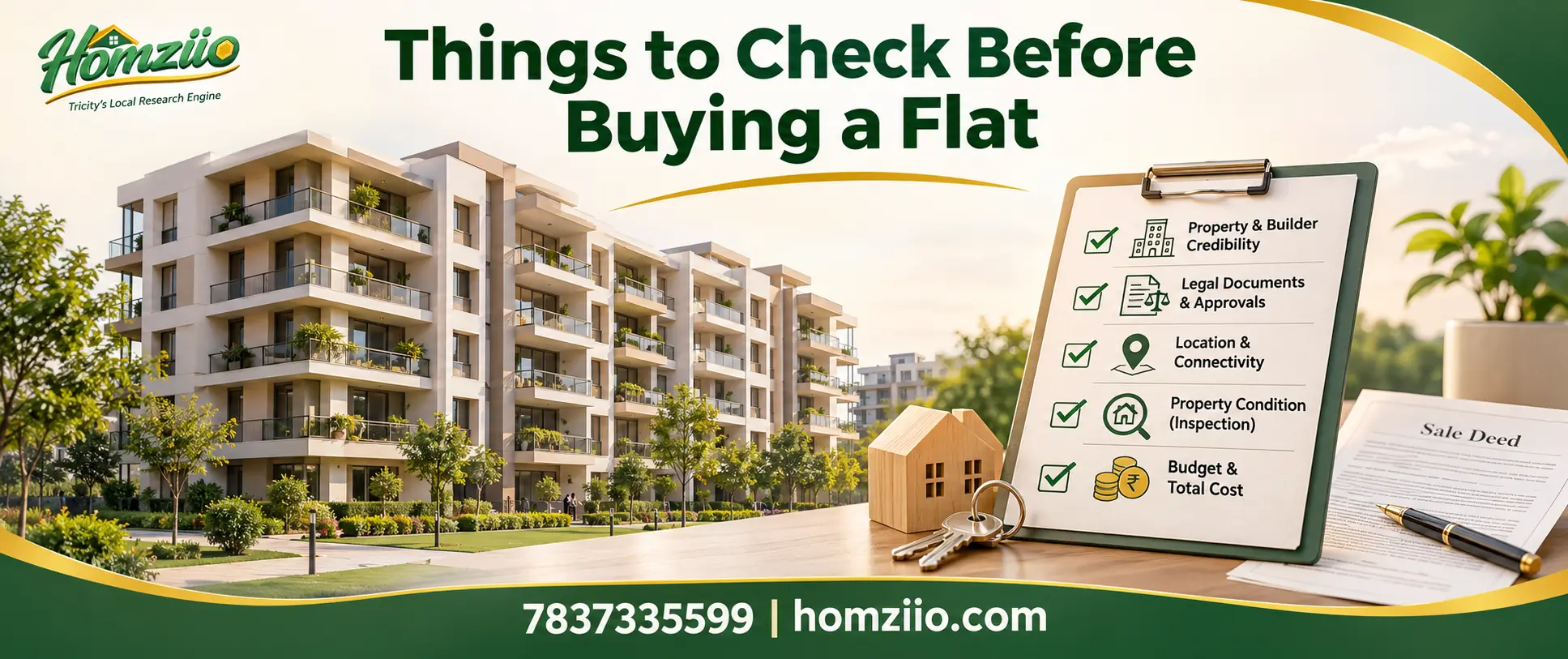
Top 4 Most Important Things to Check Before Buying a Flat
If you are short on time then start with these four checks. They protect you from the biggest risks and they are easy to remember.
- Legal papers: Check the RERA registration and the title deed and the approved plan. Clean papers keep your money and your home safe.
- Location: See how close the flat is to schools and hospitals and transport. A good location makes daily life easy and comfortable.
- Condition of the flat: Look at the walls and the plumbing and the wiring with your own eyes. Small faults today can turn into big bills tomorrow.
- Total cost: Ask for a full cost sheet and add the loan and the stamp duty to it. This way no hidden charge can surprise you later.
1: Start With the Builder and the Legal Papers
The first and most important step is to check the papers. A flat may look beautiful but without clean papers it can become a big problem. Always check the legal side before you fall in love with the design.

1.1 Check the RERA Registration
RERA stands for the Real Estate (Regulation and Development) Act. It was made to protect homebuyers and to bring honesty into the property business. Every new project above a certain size must be registered with the state RERA authority.
Ask the builder for the RERA number and then search for it on your state’s official RERA website. There you can see the project details and the promised delivery date and the builder’s past work. If you are looking at Verified RERA Projects in Mohali, you can match the number on the Punjab RERA website in just a few minutes. If a project is not registered, it is best to walk away.
1.2 Look at the Title Deed and Ownership
The title deed is the paper that proves who owns the land. The builder must have full and clear rights over the land where the building stands. If the ownership is unclear you may face a legal fight later.
Ask to see the chain of earlier owners as well. This shows how the land passed from one person to another over the years. to take Legal Consultation from a trusted property lawyer before you pay any money. A small fee for expert advice can protect you from a very big loss.
1.3 Ask for the Approved Building Plan
Every building needs a plan that is approved by the local authority. This plan shows how many floors are allowed and how the flats should be built. A builder who adds extra floors or changes the plan without permission can put your home at risk.
Compare the approved plan with what you see on the site. If the balcony or the floor count looks different from the paper then ask why. Honest builders will always answer clearly.
1.4 Confirm the Occupancy and Completion Certificates
If you are buying a ready flat then the building must have an occupancy certificate. This paper says that the building follows all the rules and is safe to live in. Without it you may face problems with electricity and water connections.
A completion certificate also matters because it shows that the work was finished as per the plan. This is one big reason why many families prefer Ready-to-Move Flats, since you can see the finished building and check these papers before you pay. Never move into a flat that does not have these certificates. Banks may also refuse to give you a loan for such a flat.
1.5 Check for Loans or Disputes on the Land
Sometimes a builder takes a loan from a bank by keeping the land as security. If that loan is not paid back the bank can take action on the property. This can put your flat in danger even if you have paid the builder in full.
Ask for a clear statement from the builder and also check the property records. A legal expert can search for court cases linked to the land. If you find any dispute it is wiser to choose another project.
1.6 Be Extra Careful With Under-Construction Projects
Under-Construction Projects often come with lower prices and easy payment plans, but they also carry more risk. The flat is not ready, so you are trusting the builder to finish on time and as promised. Check the RERA delivery date and the builder’s record of completed projects. Also make sure the payment plan is linked to the stage of construction, so you never pay more than the work done on site.
2. Look Closely at the Location
The location decides how easy or hard your daily life will be. A great flat in a bad location can become tiresome very fast. So spend time in the area before you decide.

2.1 Check Daily Needs Nearby
See whether schools and hospitals and markets are close to the flat. You will need them every week and sometimes every day. A shop or a clinic that is far away can waste a lot of your time.
Also look at the water supply and the electricity supply in the area. Talk to people who already live nearby and ask them about power cuts and water problems. Their honest words can tell you more than any brochure.
2.2 Think About Roads and Travel
Visit the area at different times of the day. Go once in the morning and once in the evening to see how busy the roads get. A quiet road at noon can turn into a traffic jam at office time.
Check how far the nearest bus stop, metro station or railway station is. If you travel to work or college daily, this matters a lot. Buyers who look at 3 BHK Flats in Tricity should also check the distance to Chandigarh, Mohali and Panchkula, because many families travel between these cities every day. A short and easy route saves both time and money.
2.3 Look at Future Growth
Find out whether new roads or malls or offices are planned in the area. Growth usually raises the value of a flat over time. An area with no plans for development may stay the same for many years.
At the same time, check for things that could harm the area, such as a new factory or a big dump yard. You can ask the local authority about future plans. This helps you see the full picture and not just the present one. Fast-growing belts like Verified Projects in Zirakpur are a good example, as new roads and shops keep adding value to the area.
3. Inspect the Flat Itself
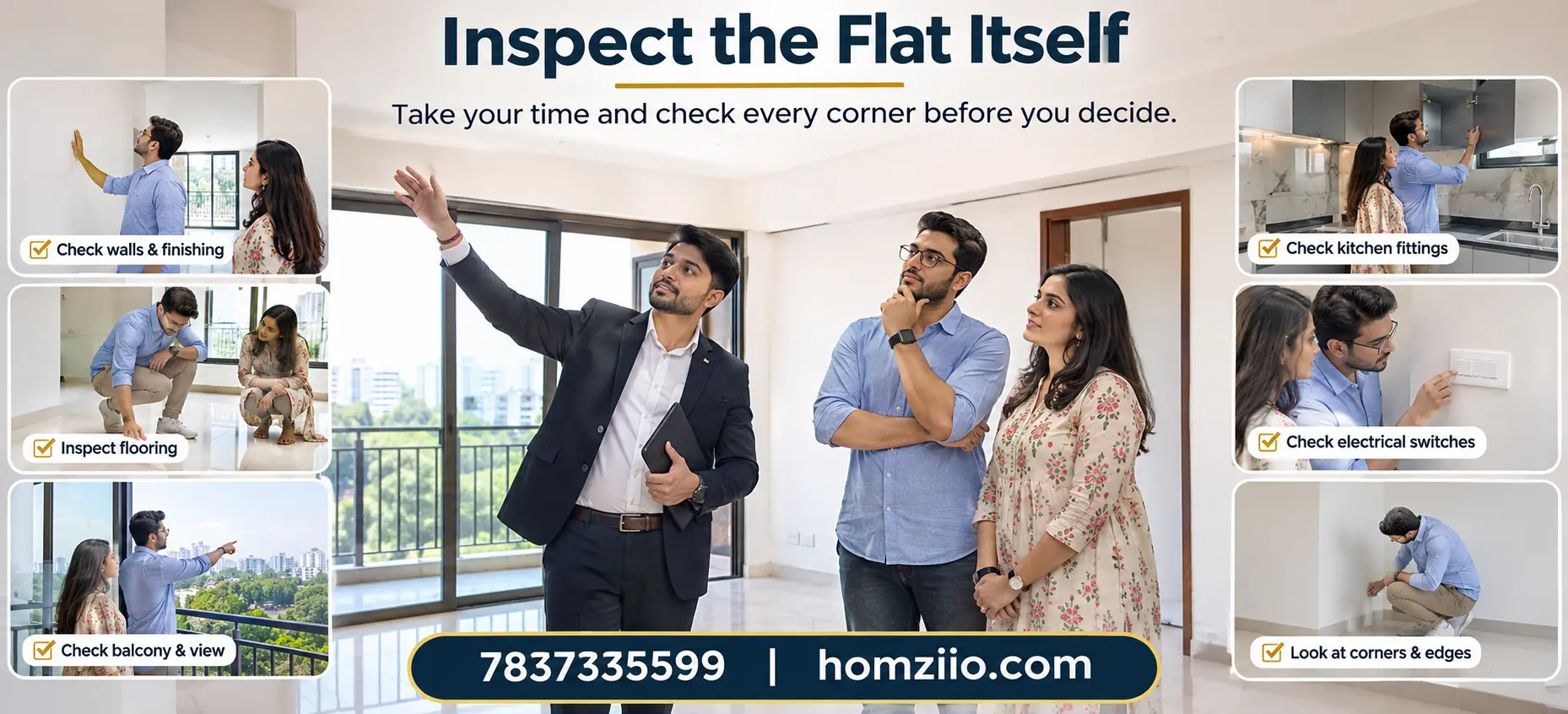
Once the papers and the location look good it is time to see the flat with your own eyes. Do not rush this step. Take your time and look at every corner.
3.1 Walls and Ceilings and Floors
Look carefully at the walls and the ceiling for cracks or damp patches. Damp patches can mean that water is leaking from somewhere. This problem can grow big and cost a lot to fix.
Tap on the floor tiles to check that none of them sound hollow. Hollow tiles may come loose after some time. Also make sure that the floor is level and not sloping.
3.2 Doors and Windows and Natural Light
Open and close every door and window to see if they work smoothly. Loose frames or broken locks are signs of poor work. Good doors and windows also keep out noise and dust.
A bright and airy flat feels happier and also saves on electricity bills. Check where the sun enters during the day and whether fresh air can pass through the rooms. Cross ventilation makes a flat feel fresh in every season.
3.3 Plumbing and Electrical Work
Turn on all the taps and flush the toilets to check the water pressure. Look under the sinks for any signs of leaks. Slow drains can point to a blocked pipe.
Check that there are enough switches and plug points in each room. Ask where the main electric board is and whether the wiring uses good quality material. Safe wiring protects your family from fire and shocks.
3.4 Know the Difference Between Carpet Area and Super Area
Many buyers get confused here so let us make it simple. Carpet area is the space inside your flat where you can actually spread a carpet. Super area includes the carpet area plus a share of common spaces like the lobby and the stairs.
Always ask the builder to tell you the carpet area in writing. Then divide the price by the carpet area to know what you are really paying for each square foot. This is especially helpful when you compare 3 BHK Flats in Tricity , because the same BHK can have a very different carpet area from one project to another. It helps you compare two flats in a fair way.
4 Understand the Full Cost Before You Pay
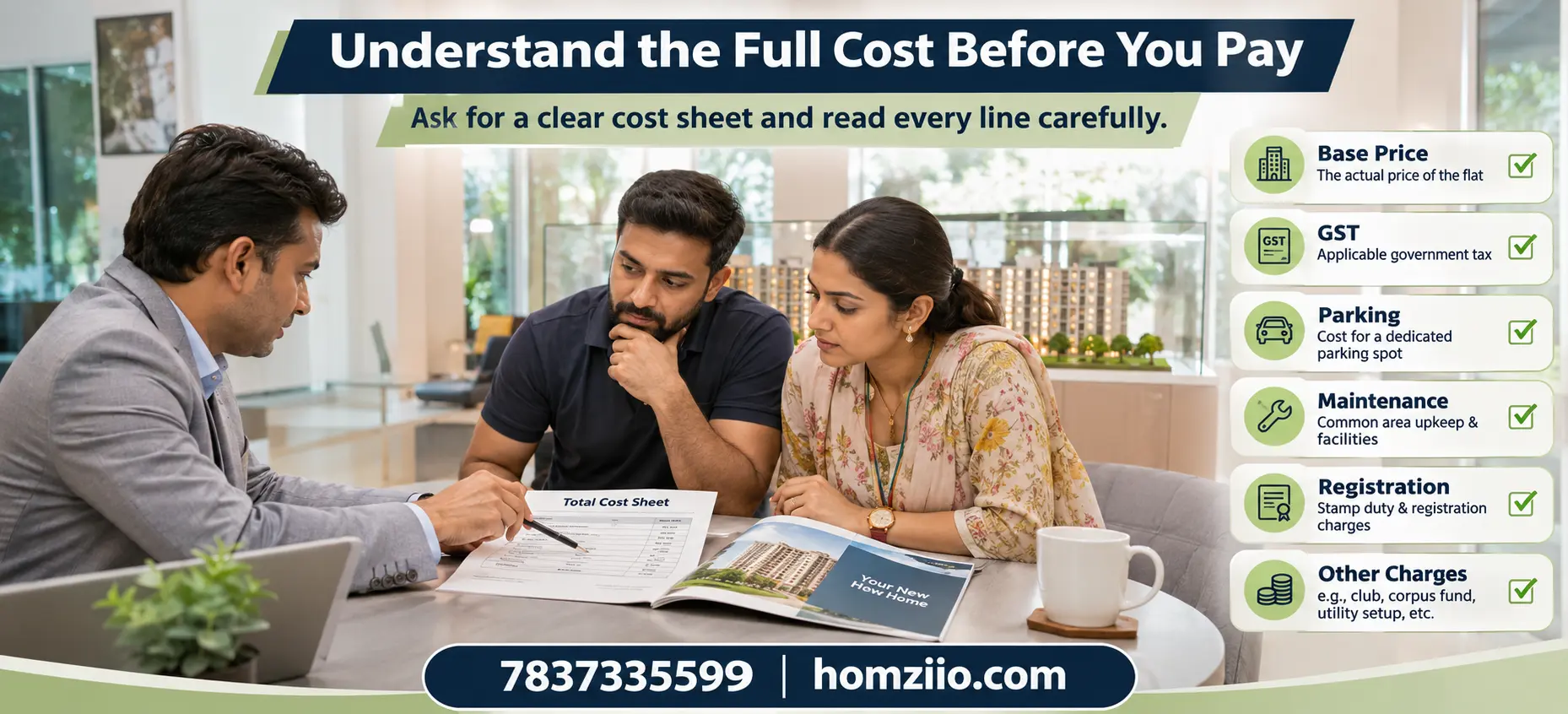
The price on the brochure is rarely the final price. Many extra charges get added later and they can shock you if you are not ready. Ask for a clear cost sheet and read every line.
4.1 Watch Out for Hidden Charges
Some builders add charges for parking and club membership and maintenance deposits. Others add fees for power backup and water connection. Each one may look small but together they can add up to a big amount.
Ask the builder to list every charge on paper and keep a copy. If something is not clear then ask until you understand it fully. A trustworthy builder will never mind your questions.
4.2 Plan Your Home Loan Wisely
Most people buy a flat with the help of a home loan. Compare the interest rates and the fees of different banks before you choose one. Even a small change in the rate can save you a lot of money over the years.
Check that the bank has approved the project because this adds a layer of safety. Also make sure that your monthly payment fits comfortably in your budget. A good rule is to keep some savings aside for emergencies.
4.3 Do Not Forget Stamp Duty and Registration
When you buy a flat you must pay stamp duty and registration fees to the government. These rates differ from state to state. They can be a big extra cost so add them to your budget from the start.
Once you pay and register the flat in your name the paper becomes your proof of ownership. Always keep the original documents in a safe place. Make copies and store them in more than one place as well.
5 Check the Society and Building Facilities
A flat is not only four walls. It is also the building and the people around it. So take a good look at the common areas and the way the society is run.

See whether the lifts work and the stairs are clean and the parking space is enough. Check if there is a fire safety system and a security guard at the gate. Good facilities make daily life smooth and safe.
Ask the current residents how the maintenance team behaves and how much monthly maintenance costs. A well managed society keeps the value of your flat strong. A badly managed one can slowly lower it.
Ready-to-Move or Under-Construction: Which One Should You Choose?
This is a question almost every buyer asks. Ready-to-Move Flats let you see the real flat, check the quality and move in without waiting. They usually cost a little more, but there is no delivery risk. Under-Construction Projects may offer a lower price and a flexible payment plan, but you must wait and trust the builder to deliver on time.
If you want peace of mind, choose a ready flat with all certificates in place. If you have time and a tight budget, choose an under-construction project, but only when it is RERA registered and the builder has a good record. For a detailed comparison, read our guide on ready-to-move vs under-construction flats.
Common Mistakes Homebuyers Should Avoid
Many people make the same mistakes again and again. Knowing them in advance will help you stay one step ahead.
Falling for Big Offers and Quick Deals
Some sellers say that the offer will end today and push you to pay fast. This is a common sales trick. A good flat will still be a good flat tomorrow so never let pressure rush you.
Paying Money Without Written Proof
Never pay any amount without a proper receipt. Keep every payment slip and every message safe. Written proof protects you if a problem comes up later.
Trusting Only Words and Not Papers
A friendly smile and a sweet promise are not legal proof. If the builder promises a swimming pool or a garden then ask for it to be written in the agreement. What is not on paper may never be delivered.
Skipping Expert Advice
Many buyers skip Legal Consultation to save a little money and regret it later. A property lawyer can read the agreement, spot unfair clauses and warn you before you sign. It is one of the cheapest ways to protect a very big investment.
A Quick Checklist You Can Save
Here is a short list you can take along when you visit a flat.
- Is the project registered with RERA?
- Does the builder have a clear title deed and an approved plan?
- Are the occupancy and completion certificates available?
- Is the location close to schools and hospitals and transport?
- Are the walls and floors and taps and wiring in good shape?
- Is the carpet area clearly written in the agreement?
- Have you received a full cost sheet with all charges?
- Is the bank loan approved and the monthly payment comfortable?
- Are the building facilities and the society management good?
Conclusion: Your Final Answer Before You Buy
Buying a flat does not have to feel scary. When you check the right things step by step you can avoid most of the problems that other buyers face. Careful buyers are always happier buyers.
Let us quickly go over the main highlights. First check the legal papers such as RERA registration and the title deed and the approved plan and the occupancy certificate. Next study the location and see how close you are to daily needs and transport. Then inspect the flat with your own eyes and look at the walls and plumbing and wiring and carpet area. After that understand the full cost including hidden charges and loan terms and stamp duty. Finally check the society and its facilities and avoid common mistakes like paying in a hurry or trusting only words.
The final answer is simple. A flat is worth buying only when the papers are clean and the location suits you and the quality is good and the total cost is clear. If even one of these is missing then wait and look at other options.
What should you do next? Make a copy of the checklist above and carry it on your next flat visit. Show all the documents to a trusted property lawyer before you pay any money. Take your time because the right flat is worth waiting for.







Rozen Singgla is a real estate analyst and co-founder of Homziio, specialising in the Chandigarh Tricity property market. With deep expertise in RERA-verified residential and commercial projects across Mohali, Zirakpur, Kharar, and Panchkula, Rozen helps buyers and investors make informed decisions backed by verified data and on-ground market insights.
News insight
 Oct 06, 2026
Ready-to-Move vs Under-Construction Flats in Tricity: Mohali, Zirakpur, Kharar, New Chandigarh & Panchkula
Ready-to-move vs under-construction flats: which one suits you? A ready flat gives quick possession,...
 Sep 15, 2026
Real Estate in Kharar Guide 2026: Complete Buyer's Handbook
Discover why real estate in Kharar is booming in 2026 verified prices, RERA-approved projects, top i...
 Sep 04, 2026
GMI Infra Group: The Real Story Behind the City's Tallest Tower
GMI Infra Group started as a jewellery business in Chandigarh and grew into a well-known real estate...