

RERA Punjab Explained: The Complete Guide to India's Real Estate Regulatory Authority

- The History and Origin of RERA
- The Real Estate Sector Before RERA
- Objectives of RERA: Why It Was Established
- The RERA Act: Key Provisions at a Glance
- RERA Implementation Timeline and State-Wise Rollout
- RERA Punjab: Governance, Project List and Project Details
- How to Check RERA Project Details Online
- Amendments to RERA Act and Its Present Status
- A Quick Checklist Before You Invest
- Conclusion
If you have ever booked a flat and then waited three, four, even seven extra years for the keys, you already know why RERAexists. Before this law came along, homebuyers had folders full of receipts and no real way to make a builder answer for a missed deadline.
Today, RERAhas quietly rewritten the rules of the game - for buyers, for builders and for anyone who simply wants to invest their savings into a home without losing sleep over it. This guide walks through everything: the history of RERA, why it was created, how RERAworks on the ground in Punjab and what a genuinely rera approved projectlooks like in 2026.
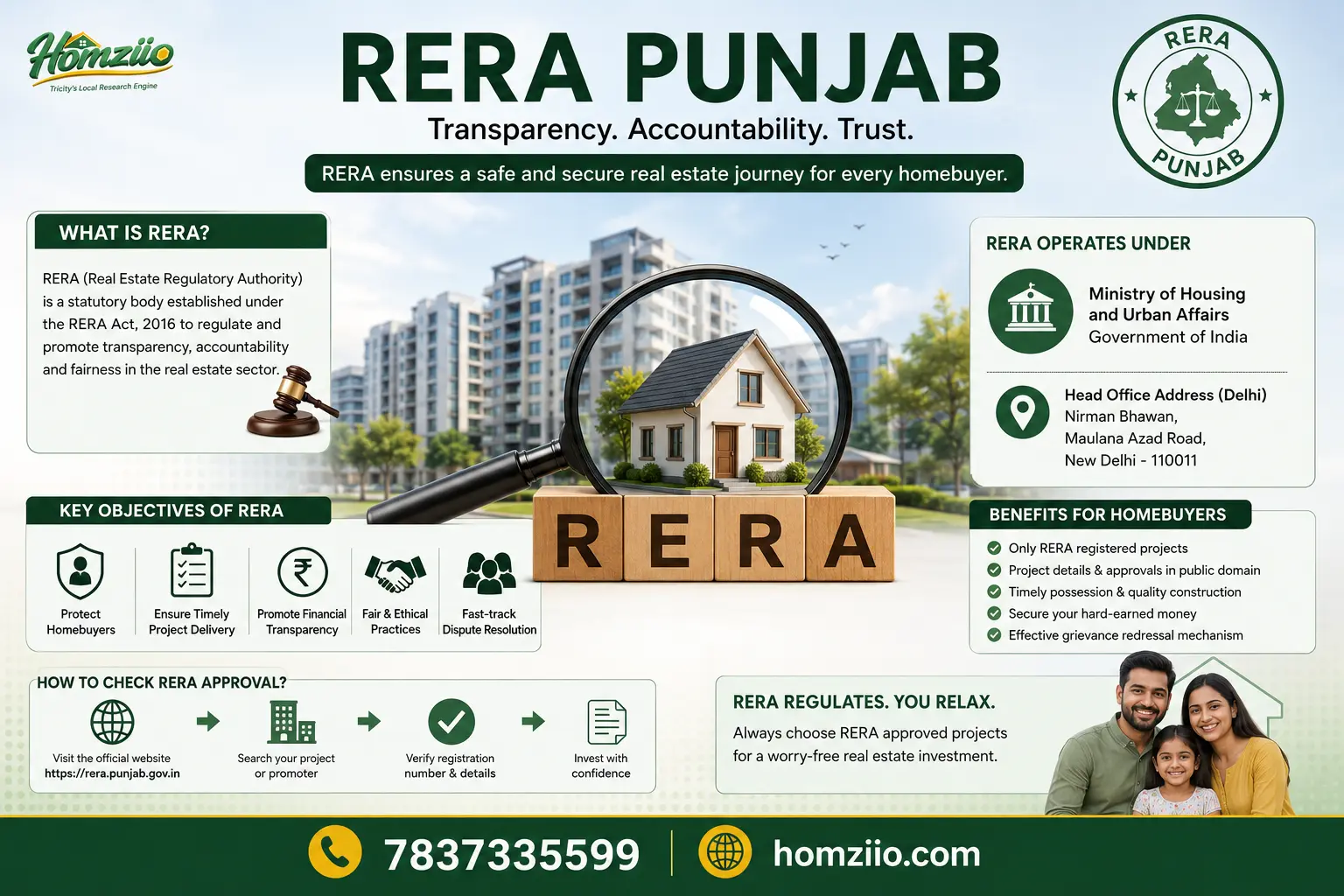
What Is RERA? Understanding the Real Estate Regulatory Authority
RERAstands for the Real Estate Regulatory Authority, the statutory body created under the Real Estate Regulation and Development Act to bring order to what was once one of the most unorganised sectors in the Indian economy.
Every state and union territory now has its own Authority - Punjab included - that registers projects, verifies promoters and gives buyers a public, verifiable window into a project's legal and financial health before they hand over a single rupee. In short, it is the referee the housing market never had.
The History and Origin of RERA
The origin of RERA goes back further than most people realise. The idea first took shape at the National Housing and Urban Development Ministers' Conference in 2009, where affordable housing and consumer protection were flagged as urgent national priorities.
Years of consultation followed with the Law Ministry, the Competition Commission and consumer affairs bodies and on 14 August 2013 the Real Estate (Regulation and Development) Billwas formally introduced in the Rajya Sabha.
RERA - Real Estate Regulatory Authority operates under India's Ministry of Housing and Urban Affairs. It is located at Nirman Bhawan, Maulana Azad Road, New Delhi, Delhi 110011,; established via the RERA Act, 2016.
Since real estate is a state subject, each state and union territory runs its own RERA authority, headquartered in its capital city - for example, Punjab RERA is headquartered in Mohali, near Chandigarh .
The RERA Actis a central law enacted by the Parliament of India in 2016 to bring transparency, accountability, and efficiency to the real estate sector. Its main goals are to protect homebuyers, ensure timely delivery of projects, reduce delays and fraud, and promote fair practices by developers and agents.
While the Act sets the uniform national framework and rules, its actual implementation happens at the state level. The central law mandates that each state/UT must establish its own Real Estate Regulatory Authority. These state authorities function as the key regulators for all real estate projects, registrations, complaints, and compliance within their jurisdiction. They have the power to register projects and agents, monitor progress, resolve disputes, and impose penalties.
This is why the authorities are named differently in each state, often with a state- specific prefix:
- Punjab- PBRERA(Punjab Real Estate Regulatory Authority)
- Haryana- HRERA(Haryana Real Estate Regulatory Authority) - note that Haryana has two bodies: one for Gurugram and one for the rest of the state (HRERA Panchkula)
- Himachal Pradesh- HPRERA(Himachal Pradesh Real Estate Regulatory Authority)
Similarly, other states have their versions, such as:
- Maharashtra - MahaRERA
- Uttar Pradesh - UP RERA
- Karnataka - K-RERA
- Gujarat - G-RERA
The bill was refined through committee review, cleared the Rajya Sabha on 10 March 2016 and the Lok Sabha on 15 March 2016 and received Presidential consent shortly after. This is the real, documented history of RERA - a nine-year journey from a policy conversation to a functioning law.
The Act came into force on 1 May 2016, with the remaining provisions notified by 1 May 2017, giving every state exactly one year to build the machinery - rules, websites and adjudicating officers - needed to enforce it.
The Real Estate Sector Before RERA
It is hard to overstate how chaotic the real estate sector before RERA actually was. There was no single authority a buyer could approach, no standard definition of what they were even paying for and almost no consequence for a builder who simply stopped answering calls. Some of the most common pre-RERA real estate problems included:
- Builder malpractices such as diverting money collected for one project into another, unrelated project.
- Chronic project delays and non-delivery, sometimes stretching a three-year promise into a decade-long wait.
- Lack of transparency in real estate pricing - buyers paid for a vague 'super built-up area' that could mean almost anything.
- No independent forum for consumer protection in real estate; disputes dragged through overloaded civil courts for years.
- Fake advertisements, unapproved layouts and last-minute changes to floor plans without buyer consent.
This was the unorganized real estate sector RERA was ultimately built to fix - one where trust was in short supply and the buyer almost always carried the risk alone.
Objectives of RERA: Why It Was Established
The objectives of RERA are refreshingly simple once you strip away the legal language. At its heart, the Act exists to:
- Establish a Real Estate Regulatory Authority in every state to register and monitor projects.
- Ensure sale of plots, apartments and buildings happens in a fair, efficient and transparent manner.
- Protect the interests of consumers in the real estate sector through mandatory disclosures.
- Create a fast-track adjudicating mechanism so disputes are resolved in months, not years.
- Bring standardisation to carpet-area definitions, escrow accounts and advertising practices.
- Boost genuine investment in the sector by restoring buyer and investor confidence.
The RERA Act: Key Provisions at a Glance
The RERA act runs into ten chapters and over ninety sections, but a handful of provisions do most of the heavy lifting for an everyday buyer:
Provision | What It Means for You |
|---|---|
Mandatory registration | Projects over 500 sq. m or 8 units cannot be sold or advertised without a RERA number. |
70% escrow rule | 70% of funds collected from buyers must sit in a dedicated account, used only for that project's construction. |
Carpet area disclosure | Pricing must be based on defined carpet area, not vague super built-up figures. |
10% advance cap | Promoters cannot collect more than 10% of the cost before a registered sale agreement is signed. |
Defect liability | Structural or quality defects reported within 5 years of possession must be fixed free of cost. |
Delay compensation | Late possession entitles buyers to a refund with interest or continued possession with interest for the delay. |
Fast-track disputes | The Authority must aim to resolve complaints within 60 days; appeals go to the Appellate Tribunal. |
Source: Real Estate (Regulation and Development) Act, 2016 and subsequent state rules.
RERA Implementation Timeline and State-Wise Rollout
The RERAimplementation timeline was staggered by design, giving states room to frame their own rules while keeping the central framework intact. Punjab notified its rules on 8 June 2017 and formally established the Real Estate Regulatory Authority, Punjab, in August 2017, with its headquarters based in Chandigarh, serving all 22 districts of the state.
RERA state-wise implementation has never been perfectly uniform - some states moved quickly, others took years to appoint a full-time chairperson or notify rules - and that unevenness is still one of the more honest criticisms of the law today. Even so, nearly every state and union territory now has an operational Authority, which was unthinkable a decade ago.
RERA Punjab: Governance, Project List and Project Details
RERA Punjab is governed by the Real Estate Regulatory Authority, Punjab, functioning under the Department of Housing and Urban Development, Government of Punjab, with its office at Sector-18A, Madhya Marg, New Chandigarh. It administers the Act across the entire state and publishes a live, public rera project list on its official portal, rera.punjab.gov.in.
Here is where the numbers matter more than adjectives. According to the Authority's own published records:
Metric | Verified Figure |
|---|---|
Total registered projects (Punjab) | 2,002 projects |
Projects with lapsed registration | 824 projects |
Districts covered | 22 districts |
Rules notified | 8 June 2017 |
Source: Real Estate Regulatory Authority, Punjab - official registered-projects list, updated May 2026.
The rera project details published for each entry are genuinely useful - promoter name, registration number, project location, sanctioned layout and direct contact information for the builder. Before you check anywhere else, this public database should be your very first stop. A project marked rera approved simply means the promoter has cleared this scrutiny and is legally allowed to sell.
RERA Punjab Registration Fees (Verified Pricing)
Applicant Type | Fee Structure |
|---|---|
Residential project (per sq. m) | ₹10 – ₹25 per sq. m., capped at ₹10 lakh |
Individual real estate agent | ₹10,000 |
Firm / company agent | ₹50,000 |
Professional assistance charges | Typically starts around ₹99,000 (market rate, not a government fee) |
Note: Government fees are set by RERA Punjab regulations and exclude GST; third-party consultancy charges vary by provider.
How to Check RERA Project Details Online
- Visit the official portal at rera.punjab.gov.in.
- Open 'Search Registered Projects' and enter the project name, promoter name or district.
- Click 'View' to see the registration number, layout approval and promoter contact details.
- Cross-check the registration number printed on every brochure or advertisement against the portal listing.
- If a project isn't listed or its registration has lapsed, treat that as a serious red flag before paying anything.
Discover Complete Builder Details with RERA
With RERA, you can easily access comprehensive builder information online. Simply visit your state's official RERA portal, search by promoter name, project or registration number to view full details. It includes the builder’s registered address, company profile, past projects, compliance status and contact information. This transparent platform empowers homebuyers to make informed decisions with just a few clicks
Amendments to RERA Act and Its Present Status
Like any young law, the amendments to RERA Act have continued to fine-tune its working - clarifying rules for project extensions, tightening timelines for uploading financial disclosures (Form 5 filings, for instance, now carry firm annual deadlines) and simplifying approvals by merging clearances such as CLU permissions with layout and building-plan sign-offs. Punjab's Authority has also introduced quarterly compliance reporting, pushing promoters to update construction progress far more often than the Act originally demanded.
The present status of RERA is, honestly, a mixed but improving picture. Delays haven't vanished overnight and enforcement still varies from state to state, but the data speaks for itself: thousands of projects are now registered and publicly searchable, escrow compliance is genuinely monitored and consumer protection in real estate finally has teeth. Real estate sector reforms driven by RERA have also nudged the industry toward better bookkeeping, cleaner titles and fewer surprises at possession - a shift that unorganised markets rarely manage on their own.
A Quick Checklist Before You Invest
- Confirm the project's RERA registration number and verify it directly on rera.punjab.gov.in.
- Read the sanctioned layout plan, not just the marketing brochure.
- Check whether the project's registration is active or lapsed.
- Ask for the promoter's litigation history, which is disclosed on the RERA portal.
- Never pay more than 10% of the cost before a registered sale agreement is signed.
Conclusion
RERAdidn't fix the Indian real estate story overnight and nobody claims it did. But it gave buyers something they never had before - a name, a number and a place to go when a promise wasn't kept. Whether you are reading the history of RERAout of curiosity or checking a rera project list before signing a cheque, the takeaway stays the same: this law exists because families deserved better than empty promises and vanishing builders. As RERAcontinues to mature across every state, one thing is certain - a well-informed buyer, armed with the right project details and a five-minute portal search, will always make a safer investment than one working on trust alone.






Rozen Singgla is a real estate analyst and co-founder of Homziio, specialising in the Chandigarh Tricity property market. With deep expertise in RERA-verified residential and commercial projects across Mohali, Zirakpur, Kharar, and Panchkula, Rozen helps buyers and investors make informed decisions backed by verified data and on-ground market insights.
News insight
 Sep 15, 2026
Real Estate in Kharar Guide 2026: Complete Buyer's Handbook
Discover why real estate in Kharar is booming in 2026 verified prices, RERA-approved projects, top i...
 Sep 04, 2026
GMI Infra Group: The Real Story Behind the City's Tallest Tower
GMI Infra Group started as a jewellery business in Chandigarh and grew into a well-known real estate...
 Aug 21, 2026
Real Estate in Zirakpur: The Complete 2026 Guide to Property, Prices and Smart Investment
Real Estate Zirakpur has grown from a Chandigarh stopover into a thriving Tricity destination. This...