

Real Estate Investing Tips 2026 A Complete Guide to Building Wealth in Indian Property

Real estate investing tips are exactly what you need if you're tired of watching property prices climb every year while you sit on the sidelines wondering when the “right time” will come. 2026 is shaping up to be a dynamic year for Indian property markets. The RBI's repo rate trajectory, RERA maturing across states, and the rise of SEBI-regulated REITs and fractional ownership platforms have all changed what “getting started” actually looks like.
Wealth building through property comes down to understanding fundamentals, spotting undervalued opportunities before everyone else does, and making calculated decisions based on data rather than emotion. This guide covers practical, actionable real estate investing tips for 2026, including rental yield math, legal verification, and tax planning, so you can build sustainable wealth through real estate investment
Why Real Estate Still Belongs in Your Wealth Plan in 2026
Every property you buy carries a quiet story behind it. Someone's rent payment becomes your loan EMI. Someone's ordinary Tuesday at work becomes the reason your equity keeps climbing in the background, month after month.
Home loan interest rates in 2026 are higher than the ultra-low years many investors got used to, and headlines love to make that sound like a reason to sit out. But rates move in cycles tied to the RBI's repo rate decisions. What doesn't change: India's urban population keeps growing, rental demand keeps climbing in metro and Tier-2 markets, and property appreciation, even at a modest pace, compounds quietly in your favor every year you hold on.
How to Start Real Estate Investing With Little Money

One of the biggest myths keeping capable people out of the market is that you need lakhs sitting in a savings account before you're “allowed” to begin. Several proven entry points let you start without draining your savings:
Fractional ownership platforms: SEBI-regulated Small and Medium REITs (SM REITs) and fractional ownership platforms let you co-own commercial or residential property for as little as ₹10 lakh to ₹25 lakh, a fraction of buying outright.
SEBI brought these platforms under a formal regulatory framework in 2024. See theSEBI regulatory framework for SM REITs for the full framework, which is what makes this option safer today than the unregulated fractional platforms of a few years ago.
REITs (Real Estate Investment Trusts): Listed REITs like Embassy Office Parks REIT, Mindspace Business Parks REIT, and Brookfield India REIT let you buy units on the NSE/BSE for the price of a single unit, ideal for beginners who want real estate exposure without a home loan.
Home loan with minimum down payment: RBI's Loan-to-Value (LTV) norms allow up to 90% financing on loans below ₹30 lakh, meaning as little as 10% down for smaller properties.
Partnering up: Pool capital with a trusted co-investor and split both the down payment and the returns, a common approach for Tier-2 city investments.
Under-construction properties with builder payment plans: Construction-linked payment plans spread your outlay over 2 to 4 years instead of a lump sum, though these carry delivery risk that needs RERA verification.
Real Estate Investing for Beginners: 5 Steps Before Your First Deal

Get your financial house in order. Check your CIBIL score (750+ opens better loan rates), calculate your debt-to-income ratio, and build an emergency reserve of 6 months' expenses.
Choose your strategy. Buy-and-hold rental, REIT units, commercial co-ownership, or a plot in a developing corridor. Your first deal should match your time commitment, not just your budget.
Get a home loan pre-approval so you know your real, usable budget before you fall for a listing you can't afford.
Build your core team early: a local agent who knows actual rental yields (not asking prices), a lawyer for title verification, and a CA familiar with property tax rules.
Start small. A modest single apartment or a co-owned commercial unit teaches you more about real ownership than any course.
Down Payment and Home Loan Rules: What Indian Lenders Actually Want
This is where most first-time investors get their gut-check. Under RBI's LTV (Loan-to-Value) guidelines, banks calculate your maximum loan based on the property's value:
Loan Amount | Maximum LTV (Loan Coverage) | Your Minimum Down Payment |
Up to ₹30 lakh | Up to 90% | 10% |
₹30 lakh to ₹75 lakh | Up to 80% | 20% |
Above ₹75 lakh | Up to 75% | 25% |
These LTV slabs are set out in the RBI Master Directions on housing finance, and are updated periodically, so always confirm the current slab with your lender before budgeting your down payment.
A few things worth knowing before you sign:
Interest rates in 2026 for home loans typically track the RBI repo rate plus a bank spread. Compare at least three lenders (public sector banks, private banks, and HFCs), since spreads vary meaningfully.
Processing fees usually run 0.5% to 1% of the loan amount.
Loans for investment or second properties sometimes carry a slightly higher rate than a self-occupied first home loan. Ask your lender to confirm this explicitly.
Under-construction property loans disburse in stages tied to construction milestones, which affects your EMI timeline.
10 Grounded Lessons for Anyone Putting Money Into Indian Property
Start with the market, not the property. Before committing to anything, research price trends over the past 3 to 5 years, rental demand in the micro-market, and planned infrastructure (metro extensions, expressways, IT corridors). A home near a transit hub or an established business district almost always finds buyers and renters faster than an isolated one.
Budget for everything, not just the purchase price. Stamp duty (typically 5% to 7% depending on state), registration charges, brokerage, GST on under-construction property, home insurance, and renovation costs add up. Set aside a reserve, since repairs and slow rental markets happen to everyone.
Let location do the heavy lifting. A modest property in a growing corridor typically outperforms a stunning one in a declining pocket. Prioritize connectivity, nearby employment hubs, and access to schools, hospitals, and daily amenities.
Match the property type to your goals. Residential and Commercial projects suit steady rental income and gradual appreciation, the easiest entry point for beginners. Commercial spaces (offices, retail, warehousing) can deliver higher rental yields but need larger capital and longer lease commitments. Land can appreciate sharply in developing regions, but title disputes are far more common, so the legal groundwork must be airtight.
Run the rental numbers before you buy. Don't guess what a property will rent for. Calculate it against comparable listings nearby.
Treat RERA and legal verification as non-negotiable. Confirm the project's RERA registration on your state's portal, check the encumbrance certificate, verify occupancy certificate (OC) and completion certificate (CC) status, and confirm the seller's title chain.
You can check a project's registration status directly on the government's Unified RERA Portal (rera.mohua.gov.in), launched by the Ministry of Housing and Urban Affairs to consolidate project data from every state and UT into one place.
Make the decision with your head, not your heart. Weigh rental yield, appreciation potential, and running costs, not how the marble flooring makes you feel.
Choose financing deliberately. Compare interest rates and processing fees across lenders. A longer tenure lowers your EMI but increases total interest paid, so model both scenarios before signing.
Give it time. Property investment rewards patience over timing. Short-term slowdowns shouldn't trigger panic-selling.
How to Analyze a Rental Property Before Buying
Run every serious listing through this checklist before getting emotionally attached:
Rental yield: Annual rent divided by property price, multiplied by 100. Indian residential yields typically run 2% to 4%; commercial can run 6% to 9%.
Vacancy allowance: Budget for 1 to 2 months of vacancy per year in your cash flow math.
Maintenance and capital reserves: Set aside roughly 1% of the property's value annually for repairs, beyond monthly society maintenance charges.
Property management costs: Budget 8% to 10% of monthly rent if you plan to hire a manager rather than self-manage.
Neighborhood fundamentals: Employment growth, planned infrastructure, and local vacancy rates matter more than listing photos.
A licensed structural inspection: Especially for resale properties. Check for seepage, structural cracks, and electrical or plumbing condition.
Worked Example: Running the Numbers on a Real Deal
Illustrative example. Figures are rounded for teaching purposes and will vary by city and property.
Suppose you're evaluating a 2BHK apartment in a Tier-2 city priced at ₹50 lakh, expected to rent for ₹18,000 per month.
Gross rental yield: (₹18,000 x 12) divided by ₹50,00,000 x 100 = 4.3%
Down payment (80% LTV slab): ₹10,00,000. Home loan: ₹40,00,000
Estimated EMI at about 9% for 20 years: roughly ₹35,900 per month
Monthly shortfall before tax benefits: ₹35,900 minus ₹18,000 rent equals ₹17,900 out of pocket
After Section 24(b) interest deduction and 80C principal deduction (subject to your tax slab and regime), the effective monthly cost is typically lower. Model this with your CA using your actual slab rate.
This is the exact math every serious buyer should run before falling for a listing. A property that looks affordable on EMI alone can still be cash-flow negative once vacancy, maintenance, and society charges are added.
Real Estate Investment vs. Other Property Options: A Comparison
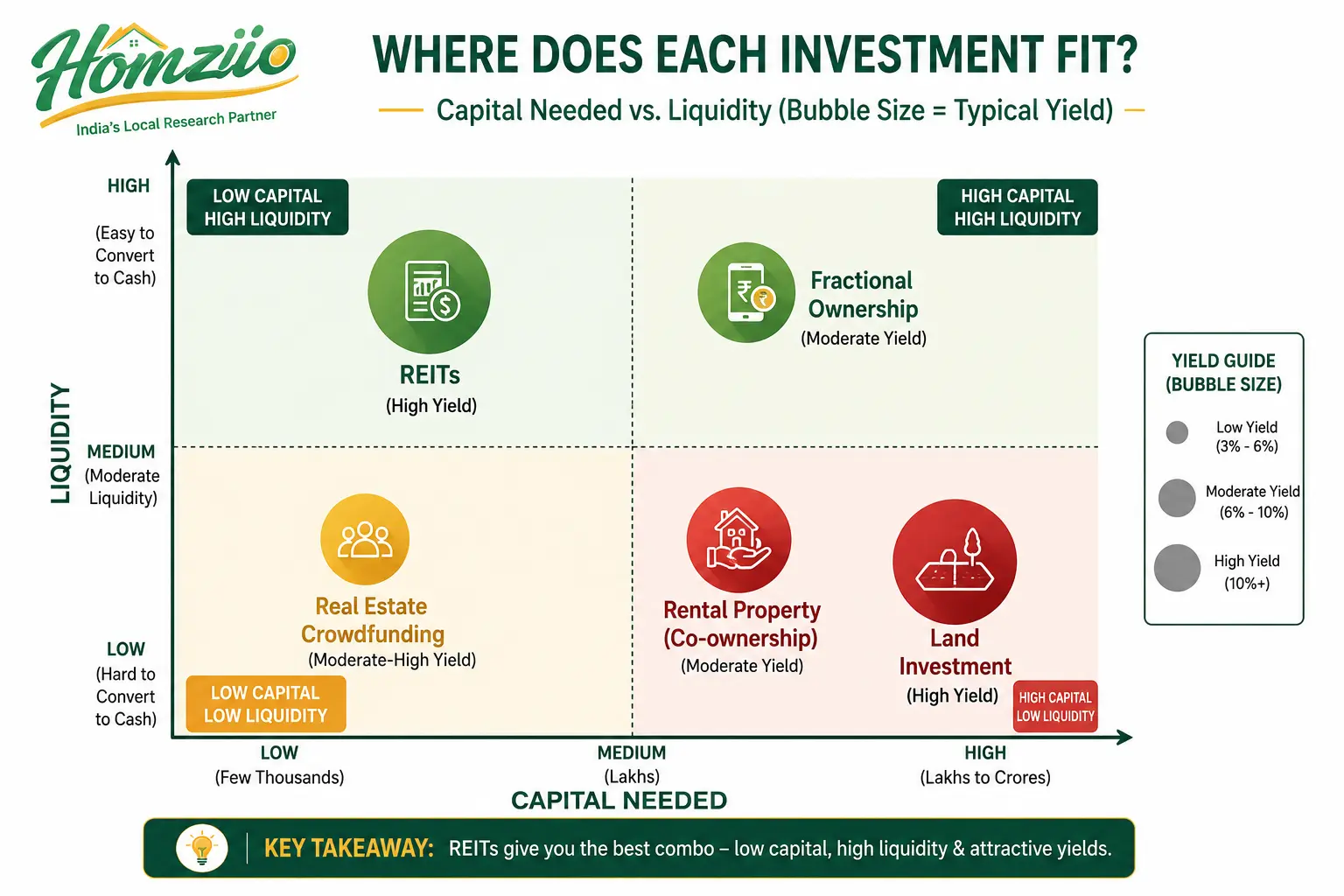
Investment Type | Capital Needed | Liquidity | Typical Yield | Best For |
Direct residential purchase | High (₹30L+) | Low | 2% to 4% + appreciation | Long-term wealth builders wanting control |
Direct commercial purchase | Very high | Low | 6% to 9% rental | Investors wanting higher yield, longer leases |
Listed REITs (Embassy, Mindspace, Brookfield) | Low (1 unit price) | High (exchange-traded) | 6% to 8% distribution | Beginners wanting exposure without a loan |
Fractional ownership / SM REITs | Medium (₹10L to ₹25L) | Medium | 8% to 10% | Commercial exposure without full ownership |
Land banking | Medium to high | Very low | Appreciation only | Long-horizon, higher-risk investors |
Tax Benefits Every Property Investor Should Know

Section 24(b): Deduction of up to ₹2 lakh per year on home loan interest for a self-occupied property (no cap for a let-out property, subject to overall loss set-off rules).
Section 80C: Deduction up to ₹1.5 lakh on principal repayment of a home loan.
Capital gains on sale: Property held over 24 months qualifies for Long-Term Capital Gains (LTCG) treatment with indexation benefit; shorter holding periods are taxed as Short-Term Capital Gains (STCG) at your income slab rate.
Section 54 / 54F exemptions: Reinvesting sale proceeds into another residential property within the prescribed timeline can exempt LTCG from tax.
TDS on property sale: Buyers must deduct TDS under Section 194-IA when the transaction value exceeds ₹50 lakh.
For the exact statutory language, see Section 24 of the Income Tax Act on the official Income Tax Department site. Always confirm current limits with a Chartered Accountant, since these figures shift with each Union Budget.
Tax rules change with each Union Budget, so verify current rates and exemption limits with a Chartered Accountant before filing or structuring a transaction. This section is educational, not tax advice.
Building a Real Estate Portfolio: Scaling Without Overreaching
Growing from one property to a genuine portfolio is about discipline, not speed. A disciplined cycle many investors follow:
Buy, improve rental readiness, rent, refinance or reinvest surplus, then repeat.
Diversifying across property types, cities, and price tiers reduces the risk of any single local downturn hurting your entire portfolio. Above all, resist over-leveraging. Keeping a healthy cash reserve across properties is what lets investors stay calm during slow months instead of panic-selling.
Real Estate Investing Mistakes to Avoid
Skipping RERA and legal verification to save time, then facing title disputes later
Underestimating vacancy periods and ongoing maintenance costs when running the numbers
Over-leveraging with too little cash reserve
Buying based on emotion or interiors instead of rental yield and appreciation data
Skipping tenant background verification to fill a vacancy faster
Chasing appreciation in weak-rental-demand areas, leaving the property cash-flow negative for years
Ignoring GST implications on under-construction property purchases
The Bottom Line
None of this requires luck. It requires research, discipline, and treating property as a financial decision rather than an emotional one. Every experienced investor you admire once stood exactly where you're standing now, unsure and searching for real estate investing tips that felt honest instead of hyped. Pick one section, whether that's analyzing your first rental property, checking RERA registration, or comparing REITs to direct ownership, and take one real step this week.
Disclaimer: This article is for educational purposes only and does not constitute financial, tax, or legal advice. Real estate investment carries risk, including loss of capital. Consult a SEBI-registered investment advisor, Chartered Accountant, or property lawyer before making investment decisions. Tax rates, LTV norms, and exemption limits are subject to change per RBI and Union Budget updates.






News insight
 Sep 15, 2026
Real Estate in Kharar Guide 2026: Complete Buyer's Handbook
Discover why real estate in Kharar is booming in 2026 verified prices, RERA-approved projects, top i...
 Sep 04, 2026
GMI Infra Group: The Real Story Behind the City's Tallest Tower
GMI Infra Group started as a jewellery business in Chandigarh and grew into a well-known real estate...
 Aug 25, 2026
GMADA Auction Results 2026: The Big Land Deals Reshaping Aerocity Mohali
GMADA's 2026 auction results reveal 50+ acres sold across Aerocity, I Block, H Block, J Block & Sect...