
Haryana Town Planning Scheme 2026: A Complete Guide to the New Residential Plotted Housing Policy for Small Municipalities
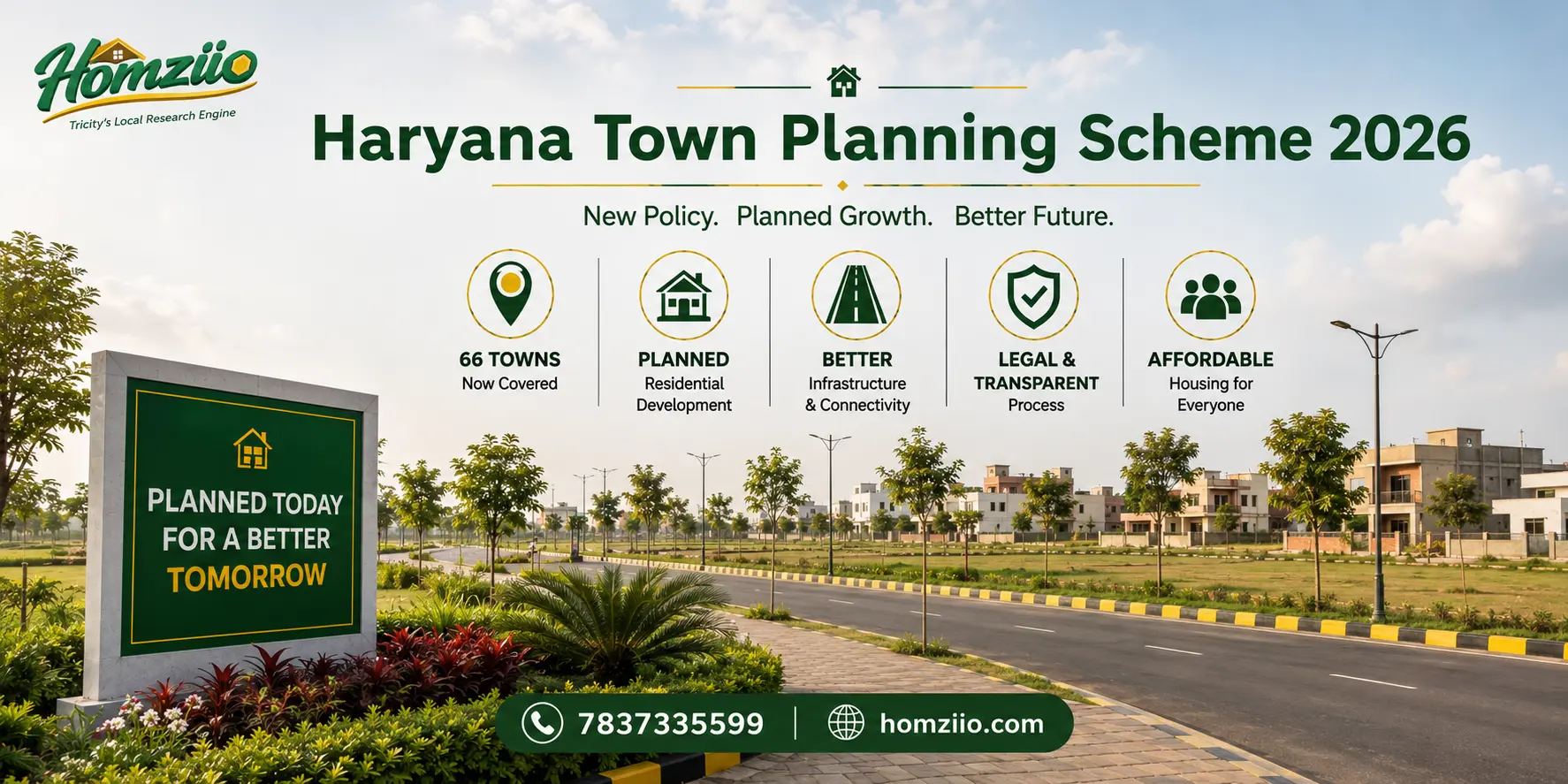
Haryana's real estate landscape just got a fresh policy push. On July 28, 2026, the Haryana Cabinet cleared a new plotted housing framework for residential development and it was formally notified on July 30, 2026 through the Haryana Urban Local Bodies Department as Notification No. 09/58/2026-4CII. This move is now widely known as the Haryana Town Planning Scheme 2026 and this news has been taken from The Tribune .
If you have been tracking land investment opportunities in the state's tier-2 and tier-3 towns, this new residential plotted housing policy is one update you cannot afford to skip.
This blog breaks down exactly what the Haryana Town Planning Scheme means, who it applies to and why it matters for anyone holding or eyeing land in Haryana's smaller municipal towns.
Why Did Haryana Introduce This New Residential Plotted Housing Policy?
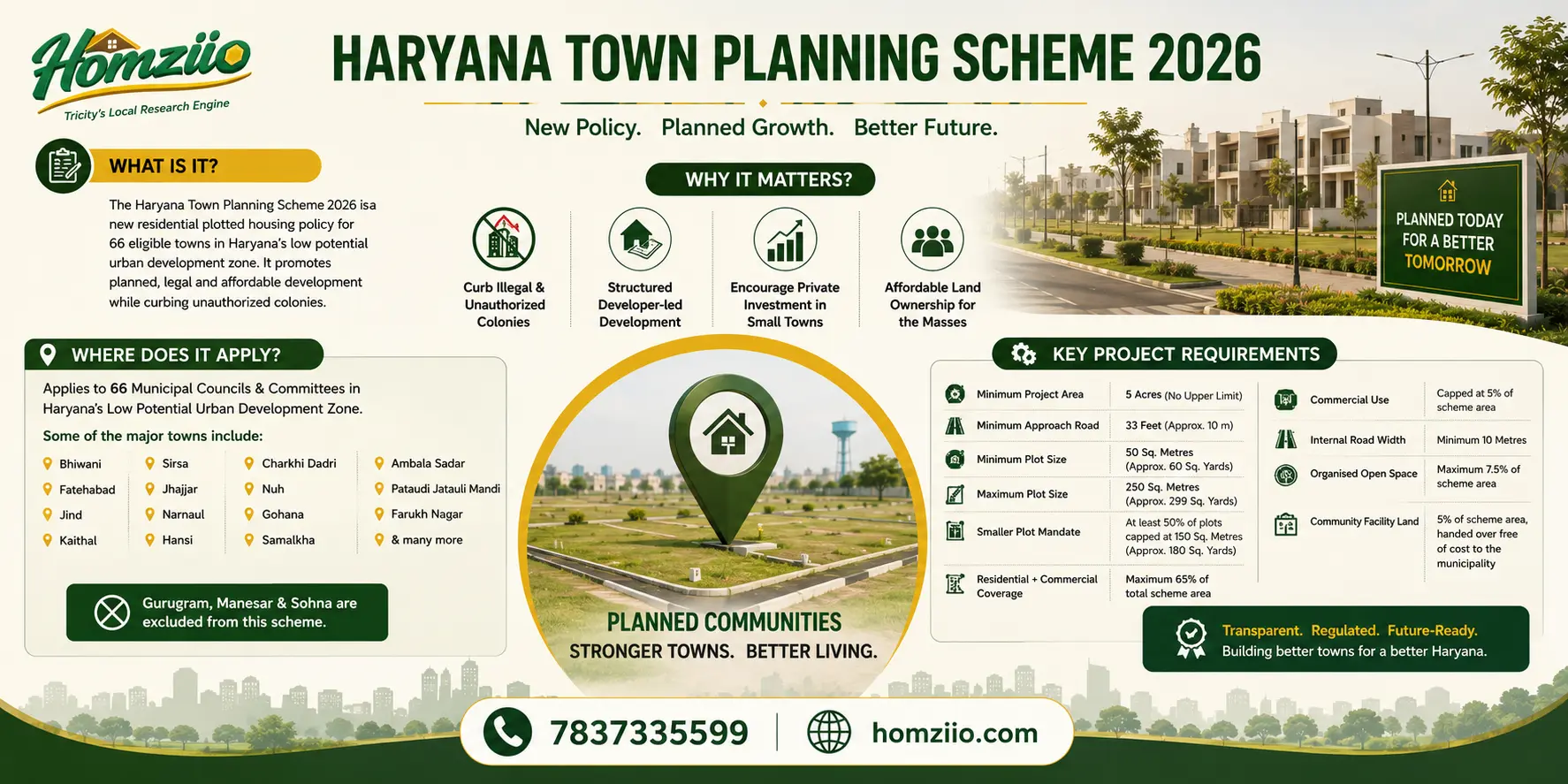
For years, many of Haryana's smaller municipal towns lacked an organised town-planning mechanism. In the absence of approved development frameworks, a large chunk of housing demand in these towns was met through unauthorized colonies. These pockets were unplanned, unregulated and often lacking basic civic infrastructure like roads, sewerage and water supply.
This gap is exactly what the new policy is designed to close. Its core objectives are to:
- Curb the growth of illegal and unauthorized colonies
- Create a structured, developer-led route for planned residential plotted development
- Encourage private investment in low-potential urban development zones
- Make land ownership more affordable and accessible for the masses in smaller towns
In short, this new residential plotted housing policy is Haryana's attempt to formalise and modernise urban growth outside its already-saturated metro corridors.
Which Areas Does the Haryana Town Planning Scheme Cover?
This is where clarity matters most for investors. The Haryana Town Planning Scheme is not a blanket policy for the entire state. It applies specifically to 66 municipal councils and municipal committees located in Haryana's low potential urban development zone, together forming the official list of eligible plotted housing areas under this notification.
Some of the notable towns included in the eligible list are:
- Bhiwani
- Fatehabad
- Jind
- Kaithal
- Sirsa
- Jhajjar
- Narnaul
- Hansi
- Charkhi Dadri
- Nuh
- Gohana
- Samalkha
- Ambala Sadar
...and dozens of other smaller municipal towns spread across the state.
What About Gurugram, Manesar and Sohna?
This is the most important clarification for anyone assuming this policy opens up new development potential in Haryana's premium micro-markets: Gurugram city, Manesar and Sohna are excluded from this scheme. These regions are already governed by their own controlled area provisions and are considered developed urban zones, so they fall outside the scope of this particular notification.
That said, Gurugram district is not entirely absent from the list. Two specific entries, Pataudi Jatauli Mandi and Farukh Nagar, are included in the official annexure. Even here, eligibility is not automatic for every plot; it depends on whether the specific parcel of land falls in an area where controlled-area restrictions do not apply and whether the project separately receives approval under the scheme.
Key Eligibility & Project Requirements Under the Haryana Town Planning Scheme
Before any developer can move forward under the Haryana Town Planning Scheme, certain minimum thresholds must be met, starting with the baseline for 5-acre land development projects. Here is what the notification lays out:
Parameter | Requirement |
Minimum project area | 5 acres (no upper limit) |
Minimum approach road width | 33 feet (roughly 10 metres) |
Minimum plot size | 50 sq. metres (approx. 60 sq. yards) |
Maximum plot size | 250 sq. metres (approx. 299 sq. yards) |
Smaller-plot mandate | At least 50% of residential plots capped at 150 sq. metres (approx. 180 sq. yards) |
Residential + commercial coverage | Maximum 65% of total scheme area |
Commercial use | Capped at 5% of scheme area |
Internal road width | Minimum 10 metres |
Organised open space | Maximum 7.5% of scheme area |
Community facility land | 5% of scheme area, handed over free of cost to the municipality |
The 50% Affordability Rule: The Real Game Changer
Perhaps the most people-friendly clause in this policy is the requirement that at least half of all residential plots in a project cannot exceed 150 square metres, roughly 180 square yards. This effectively guarantees a steady supply of affordable residential plots in every project.
This affordability clause sits at the heart of the new residential plotted housing policy, ensuring that developers cannot corner entire projects into large, high-ticket plots. Instead, a meaningful share of affordable, smaller plots reaches everyday buyers.
For families and first-time land buyers in tier-2 Haryana towns, this translates into a wider pool of reasonably priced, legally sanctioned residential plots, a marked improvement over the unregulated colony market many were previously forced to rely on.
Infrastructure & Sustainability Standards Built Into the New Residential Plotted Housing Policy
Unlike older, looser development norms, the Haryana Town Planning Scheme embeds several modern infrastructure and environmental obligations on developers, including:
Solar-powered street lighting for at least 50% of all streetlights within the project
A dedicated solid waste management zone of at least 50 sq. metres
A Sewage Treatment Plant (STP) with 100% recycling of treated water for landscaping and open spaces
At least 20% of the road right-of-way to be soft-paved for natural groundwater recharge, along with rainwater harvesting provisions in public parks
This positions the scheme as more than just a plotting policy. It is designed to produce planned, civic-infrastructure-ready townships rather than the ad-hoc colonies that have historically defined semi-urban Haryana.
Regulatory Safeguards for Buyers
Homziio always advises clients under this new residential plotted housing policy to look beyond the headline benefits of any new policy and understand the compliance layer protecting them as buyers. Here is what this scheme mandates on that front:
Compulsory HRERA registration: Developers cannot advertise, accept bookings or execute any sale agreement before securing HRERA registration for the project.
Mandatory disclosure: All approved scheme parameters must be reflected in allotment letters and sale agreements, preventing developers from promising anything beyond what is officially sanctioned.
Mortgage or bank guarantee requirement: Developers must either mortgage 15% of the saleable residential area or furnish a bank guarantee worth 25% of the estimated internal development cost, ensuring infrastructure actually gets built.
Five-year completion timeline: Projects are expected to be completed within five years of receiving permission, with extensions granted only after due enquiry.
Post-completion maintenance: Developers remain responsible for maintaining roads, parks and public-health infrastructure for five years after the completion certificate, before handover to the local authority.
What This Scheme Does NOT Do
To avoid any confusion in the market, it is equally important to understand the limits of these rules. This policy
Does not apply automatically across all of Haryana
Does not cover Gurugram city, Manesar or Sohna
Does not regularize existing unauthorized colonies or construction
Does not grant individual plot owners automatic construction rights
Does not override the Haryana Building Code 2017; FAR, height, parking and ground coverage norms still appl
Does not eliminate the need for HRERA registration or building-plan approvals
What Does This Mean for Investors and Landowners?
If you own or are considering 5 acres or more of land in one of the 66 eligible municipalities, the Haryana Town Planning Scheme could open a legitimate, government-backed route to a developer-led plotted colony model , something that was previously far more restrictive in smaller towns without an organised town-planning mechanism.
Here is why this matters for real estate investors in 2026:
- Lower entry barriers for smaller towns: With planned infrastructure now mandated, land in these low-potential zones is likely to see improved valuation over time as unauthorized-colony risk reduces.
- Structured demand from affordable buyers: The 50% small-plot mandate creates a steady buyer base looking for legally compliant, moderately priced plots.
- Reduced legal risk: HRERA registration and mandatory disclosures significantly cut down the fraud and litigation risks historically associated with unregulated colonies.
- Long-term appreciation potential: As these municipalities transition from unplanned growth to organized townships, early movers in eligible zones stand to benefit most.
However, this also means due diligence is non-negotiable. Before any transaction, verify:Whether the municipality is genuinely listed in the official annexure
- Whether the specific land parcel falls outside controlled-area restrictions
- Whether the project has secured actual permission under the scheme, not just claimed eligibility
- HRERA registration status directly on the official portal
- Mortgage status of the specific plot in question
How Homziio Can Help
With over 20 years of ground experience across Haryana's real estate market and a network spanning 500+ delivered projects , Homziio is uniquely positioned to help you navigate this policy, whether you are a landowner exploring development potential, a developer seeking project partners or a buyer looking for a verified, compliant plot in one of the newly eligible towns.
Our team tracks every policy notification, gazette update and municipal annexure change as it happens, so our clients never have to rely on secondhand or outdated information when evaluating this opportunity.
Looking to explore land or plotted housing opportunities under this new policy? Connect with Homziio's advisory team today at 7837335599 for a parcel-specific eligibility check and investment consultation.







Rozen Singgla is a real estate analyst and co-founder of Homziio, specialising in the Chandigarh Tricity property market. With deep expertise in RERA-verified residential and commercial projects across Mohali, Zirakpur, Kharar, and Panchkula, Rozen helps buyers and investors make informed decisions backed by verified data and on-ground market insights.
News insight
 Oct 06, 2026
 Ready-to-Move vs Under-Construction Flats in Tricity: Mohali, Zirakpur, Kharar, New Chandigarh & Panchkula
Ready-to-move vs under-construction flats: which one suits you? A ready flat gives quick possession,...
 Sep 15, 2026
 Real Estate in Kharar Guide 2026: Complete Buyer's Handbook
Discover why real estate in Kharar is booming in 2026 verified prices, RERA-approved projects, top i...
 Sep 04, 2026
 GMI Infra Group: The Real Story Behind the City's Tallest Tower
GMI Infra Group started as a jewellery business in Chandigarh and grew into a well-known real estate...