
Haryana Property Tax New Formula 2026: Is Your House Tax Bill About to Change?

If you own a home anywhere between Panchkula and Panipat, there is a piece of paperwork sitting in a government file right now that will decide how much you pay every year to keep that home yours on record.
The Haryana Property Tax New Formula , approved by the state cabinet under Chief Minister Nayab Singh Saini, has quietly replaced a system that had run the show since 2013 and it rewrites the maths behind every house tax bill in the state. For years, homeowners complained that assessments felt arbitrary, that two near-identical houses on the same street could land wildly different bills and that almost nobody outside the tax office truly understood how the number on the challan was arrived at.
The Haryana Property Tax New Formula was built to fix exactly that problem, replacing guesswork with a plain formula anyone can check for themselves. This is why Haryana house tax 2026 has become one of the most searched property topics in the state. Whether you already own a flat in Sector 20, Panchkula or are still deciding where to invest next , understanding the Haryana Property Tax New Formula is no longer optional homework. It is now essential reading.
Why Did Haryana Even Need a New Tax Formula?
Think about the last time you paid your house tax. Did you know exactly how the amount was calculated or did you simply trust the number and pay it? For most Haryana homeowners, the honest answer is the second one.
The old system, notified back in 2013, relied heavily on discretionary assessment. Tax officials worked with a mix of factors that were not always transparently applied, which meant two identical plots could be assessed differently depending on who reviewed the file. Over time this bred distrust, delayed payments and a steady stream of disputes and objections at municipal offices across the state.
The Haryana Cabinet finally addressed this in a meeting chaired by CM Nayab Singh Saini, giving in-principle approval to a new property tax methodology Haryana Municipal Corporation and municipal council offices will now follow for every building and plot of land within their limits.
The new rules are notified separately for Municipal Corporations under the Haryana Municipal Corporation Act, 1994 and for Councils and Committees under the Haryana Municipal Act, 1973 and they officially supersede the 2013 notifications.
So What Exactly Is the New Formula?
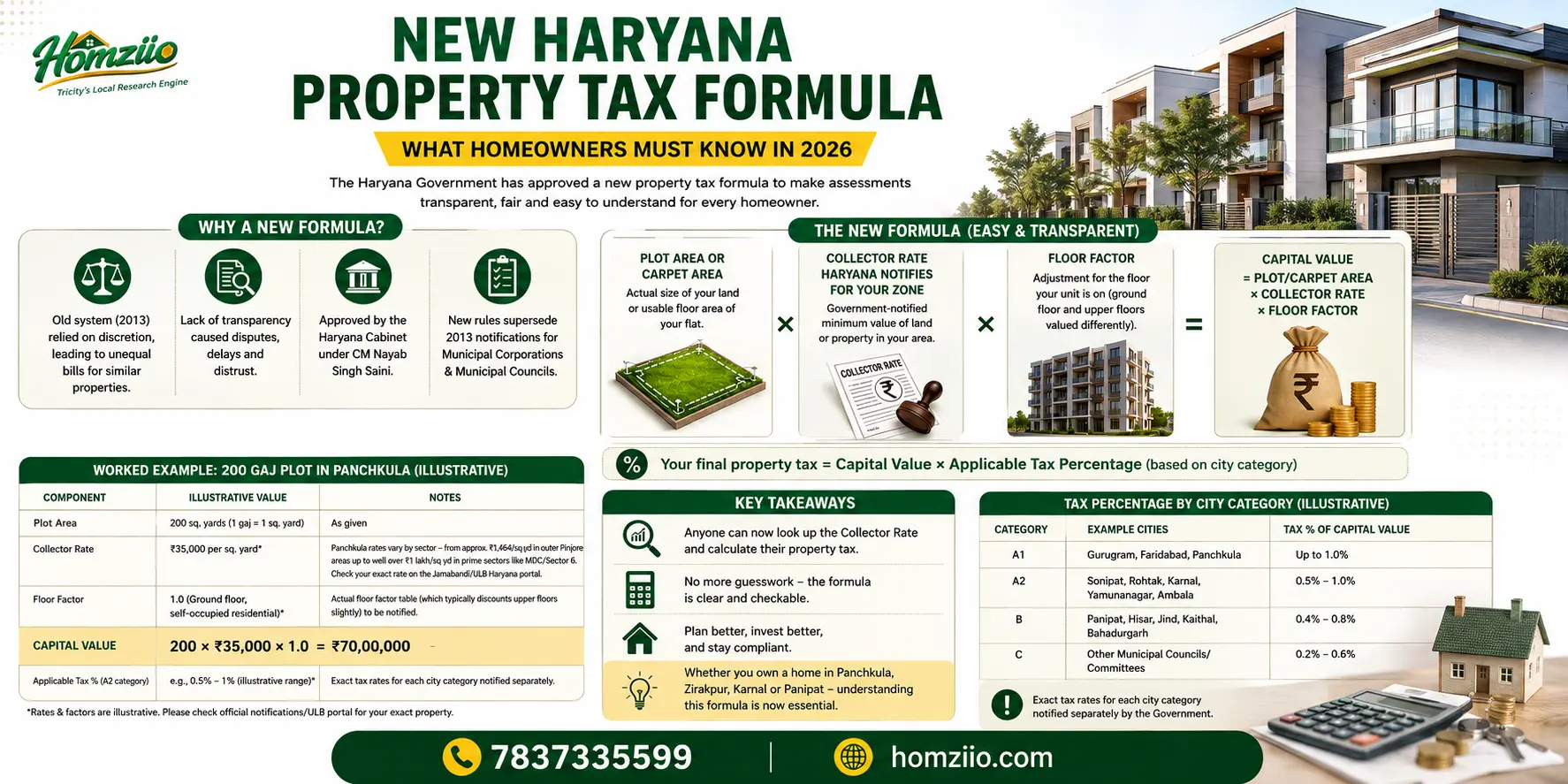
As per the recent news from The Times of India . Here is the part every homeowner actually wants to know. Instead of discretionary assessment, the new system runs on a clear, formula-driven Capital Value calculation . This Capital Value calculation replaces years of guesswork with three visible, checkable inputs rather than an official's judgment call. Once the Capital Value is known, a prescribed tax rate is applied to it based on your city's category.
Component | What It Means For You |
|---|---|
Plot Area or Carpet Area | The actual size of your land or the usable floor area of your flat, whichever applies to your property type. |
Collector Rate Haryana notifies for your zone | The government-notified minimum value of land or property in your area, used for stamp duty and now for tax too. |
Floor Factor | An adjustment that accounts for which floor your unit sits on, since ground-floor and upper-floor units are valued differently. |
Put together, the formula reads: Capital Value = Plot Area (or Carpet Area) x Collector Rate x Floor Factor. Your final property tax is then a percentage of this Capital Value and that percentage depends on which category your city falls under. Anyone can now look up the Collector Rate Haryana has notified for their own zone instead of waiting on an assessor's opinion.
Worked example: 200 Gaj plot in Panchkula
Component | Illustrative value | Notes |
Plot Area | 200 sq. yards | Panchkula's property measurement is in Gaj, so here to calculate; 1 gaj= 1 yard, so accordingly 200 Gaj =200 square Yard. |
Collector Rate | ₹35,000 per sq. yard | Panchkula's actual notified rate varies hugely by sector, from roughly ₹1,464/sq yd in outer Pinjore areas up to well over ₹1 lakh/sq yd in prime sectors like MDC/Sector 6. Must be looked up sector-wise on the Jamabandi/ULB Haryana portal for the real address. |
Floor Factor | 1.0 (ground floor, self-occupied residential) | Actual floor factor table (which typically discounts upper floors slightly) hasn't been publicly notified with numbers yet |
Capital Value | 200 × ₹35,000 × 1.0 = ₹70,00,000 | The exact value for illustration is 200 yards combined with collector rate along with Floor factor rate |
Applicable tax % (A2 category) | e.g.,0.5%–1% (illustrative range) | The exact floor/ceiling percentage for A2 cities specifically hasn't been published in the sources available yet |
Annual Property Tax | 0.5%of ₹70,00,000 = ₹35,000 1%of ₹70,00,000 = ₹70,000 | Illustrative range only |
How Are Haryana's Cities Categorised Now?
Not every city in Haryana carries the same cost of living or the same civic infrastructure budget, so a one-size-fits-all rate would never have been fair. The new Haryana Municipal Corporation tax rules sort every Urban Local Body into one of four categories, with a floor rate and a ceiling rate prescribed for each. This gives municipalities room to set local rates within those limits based on their own needs, while still keeping the whole state within a predictable, transparent band.
Category | Applies To | Governing Law |
|---|---|---|
A1 | Larger Municipal Corporations | Haryana Municipal Corporation Act, 1994 |
A2 | Other Municipal Corporations | Haryana Municipal Corporation Act, 1994 |
B | Municipal Councils | Haryana Municipal Act, 1973 |
C | Municipal Committees | Haryana Municipal Act, 1973 |
Note for readers: the exact floor and ceiling tax percentages for each category are being notified city-wise by individual ULBs, including for Panchkula property tax new rules specifically. Always confirm the current rate for your specific municipality on the official ULB Haryana property tax portal before making any payment decisions.
A Simple Example How Would This Actually Work?
If you have been searching how to calculate house tax in Haryana 2026, this step-by-step walkthrough is for you. Picture a homeowner in Panchkula who owns a 200 square yard plot.
Under the new system, the municipal office would first check the collector rate notified for that specific sector, then multiply it by the plot area and the applicable floor factor to arrive at the Capital Value.
The prescribed percentage for that city's category is then applied to this Capital Value to get the final annual tax.
- Step 1: Confirm your Plot Area or Carpet Area from your registry documents.
- Step 2: Look up the curre nt Collector Rate Haryana has notified for your zone or sector.
- Step 3: Apply the Floor Factor relevant to your unit's floor level.
- Step 4: Multiply the three to complete your Capital Value calculation .
- Step 5: Apply your city's prescribed tax rate to the Capital Value to see your payable tax.
This walkthrough is illustrative only and uses no actual collector rate or tax percentage. Use the official ULB Haryana self-assessment tool for a figure you can rely on.
Will Your Tax Bill Suddenly Double Overnight?
This is usually the first fear that crosses a homeowner's mind and it is a fair one. The good news is that the government has built in real safeguards. Any rise in tax liability under the new system is capped and will be phased in gradually until the fully revised assessed value is reached, rather than being applied in one shock instalment.
Property owners who have already paid their dues will face no impact from the new methodology till Financial Year 2026-27 and arrears or interest pertaining to Financial Year 2025-26 and earlier will remain unaffected by the change. In short, the transition has been designed to be felt gradually, not as a sudden jolt to the household budget.
Who Is Completely Exempt From This Tax?
In the larger public interest, the new policy also carves out wide-ranging exemptions, recognising that not every property in a city exists to generate income. If you fall into one of these categories, it is worth checking whether you qualify for full or partial relief.
- Religious properties such as temples, churches, gurudwaras and mosques that offer public services free of charge get a 100% exemption.
- Municipal properties that are not leased out or rented to anyone.
- Orphanages, almshouses, dharamshalas, cremation grounds and burial grounds.
- Government educational institutions and government hospitals.
- Land used exclusively for agricultural purposes.
- Gaushalas, as long as any commercial activity stays limited to milk, dairy products or ganic fertilisers, Bio-CNG or biogas, cow dung and cow urine.
- The Haryana property tax exemption for ex-servicemen covers self-occupied residential houses up to 250 square metres belonging to serving or ex-servicemen, paramilitary personnel and families of deceased soldiers.
What Should Homeowners Do Right Now?
You do not need to panic, but you also should not ignore this. A little preparation today can save you a confusing dispute later. Here is a practical checklist worth acting on this month.
- Log in to the ULB Haryana property tax portal and confirm your property's current recorded plot area or carpet area is accurate.
- Check whether the collector rate for your specific sector or zone has recently been revised, since several NCR districts saw collector rate hikes moving into FY 2025-26.
- Keep your registry papers, latest tax receipt and any exemption-related documents such as ex-servicemen certificates ready and accessible.
- If you believe your property qualifies for an exemption, raise it with your local ULB office proactively rather than waiting for a fresh demand notice.
- Watch for the official, city-wise notification of tax rates for your category, since state-level approval is only the first step before local implementation.
The Bottom Line: A Fairer System, If You Stay Informed
Change to something as personal as your house tax bill can feel unsettling, especially when it touches the home you have worked years to build or buy. But the Haryana Property Tax New Formula is, at its heart, an attempt to replace confusion with clarity.
The Haryana Property Tax New Formula trades subjective, discretionary assessment for a transparent equation built on plot area, collector rate and floor factor, so every homeowner can eventually check their own bill instead of simply trusting an unseen calculation.
With phased implementation, a cap on sudden increases and genuine protection for dues already paid, the Haryana Property Tax New Formula has clearly been designed with real households in mind, not just revenue targets.
The most important thing you can do now is stay informed, verify your own property details on the ULB Haryana portal and make sure the Haryana Property Tax New Formula works in your favour rather than catching you off guard.
Homziio is Chandigarh Tricity’s trusted no-brokerage platform for verified homes. Buy, sell or rent flats, plots and projects in Mohali , Zirakpur, Panchkula and beyond- transparent deals, real data, zero middlemen. Stay informed, choose wisely and find the right property at the right price.







Rozen Singgla is a real estate analyst and co-founder of Homziio, specialising in the Chandigarh Tricity property market. With deep expertise in RERA-verified residential and commercial projects across Mohali, Zirakpur, Kharar, and Panchkula, Rozen helps buyers and investors make informed decisions backed by verified data and on-ground market insights.
News insight
 Oct 06, 2026
 Ready-to-Move vs Under-Construction Flats in Tricity: Mohali, Zirakpur, Kharar, New Chandigarh & Panchkula
Ready-to-move vs under-construction flats: which one suits you? A ready flat gives quick possession,...
 Sep 15, 2026
 Real Estate in Kharar Guide 2026: Complete Buyer's Handbook
Discover why real estate in Kharar is booming in 2026 verified prices, RERA-approved projects, top i...
 Sep 04, 2026
 GMI Infra Group: The Real Story Behind the City's Tallest Tower
GMI Infra Group started as a jewellery business in Chandigarh and grew into a well-known real estate...