GMADA: The Story of How a Development Authority Rebuilt Mohali From Farmland Into a Future
There is a particular kind of trust a family places in a piece of paper before they place their savings on a piece of land. They want to know that the plot they are buying today will not turn into a legal nightmare tomorrow.
In the Greater Mohali region, that trust has a name: GMADA.The Greater Mohali Area Development Authority, has quietly shaped almost every sector, road and skyline you see between Mohali, Zirakpur, Kharar and New Chandigarh.
If you have ever asked what GMADA actually is, why it exists or how a government body ended up controlling something as personal as your dream home, you are about to get the full, honest answer.
This blog walks through the history of GMADA, how GMADA works, its plot schemes, its biggest upcoming projects and the safeguards it offers every homebuyer who trusts it with their money.
What Is GMADA and Why Was It Created ?
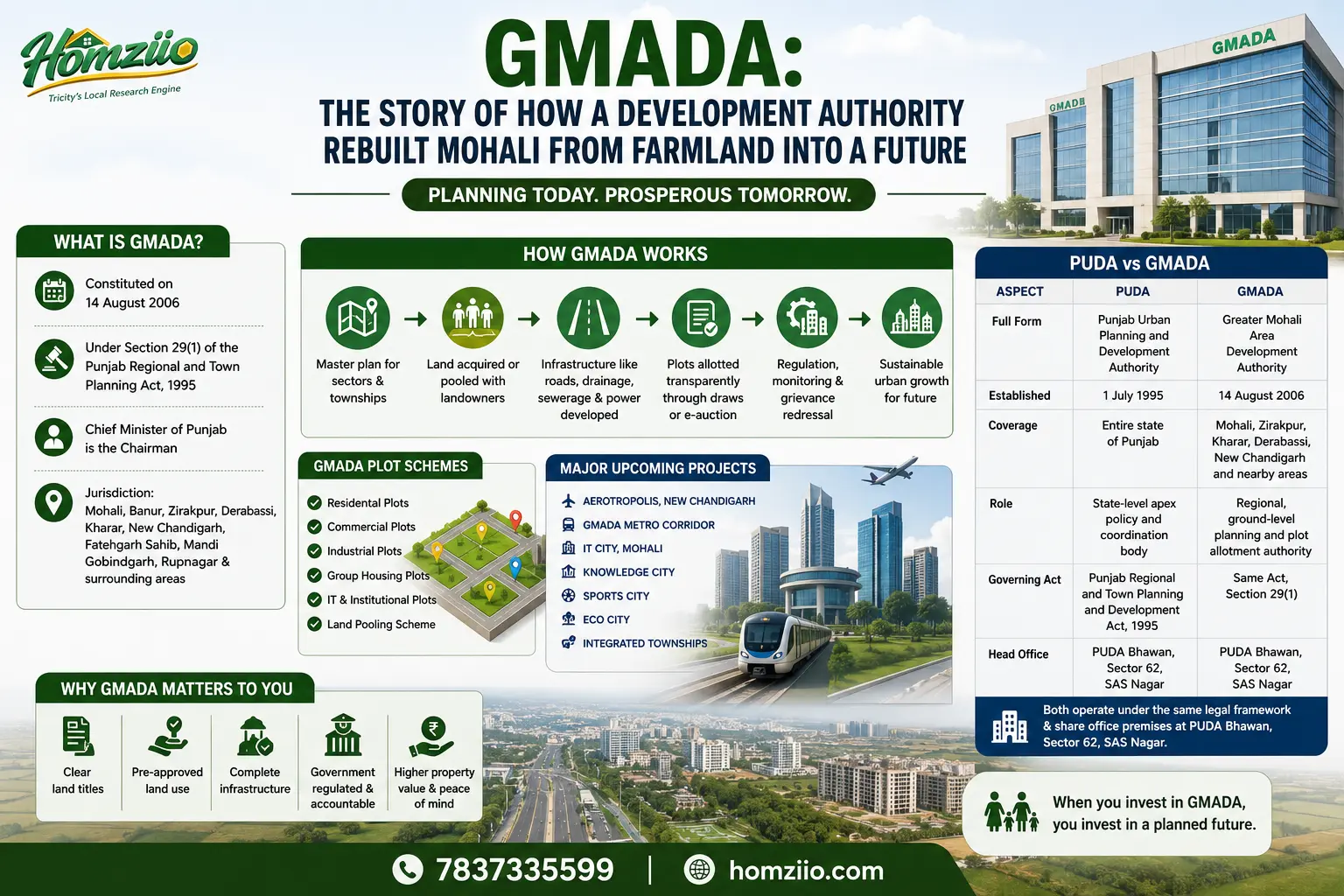
GMADA: Greater Mohali Area Development Authority, was constituted on 14 August 2006 through an official Punjab Government notification, under Section 29(1) of the Punjab Regional and Town Planning Act, 1995. That single sentence carries a lot of weight, so let us unpack it.
Before 2006, Mohali and its surrounding villages were growing in a scattered, unplanned way. Farmland was being converted into housing colonies without proper roads, sewerage or drainage. Punjab needed a dedicated authority that could plan this specific region with foresight rather than let private colonisers decide the city's fate one plot at a time.
So the state government used the powers granted under the Punjab Regional and Town Planning and Development Act, 1995, to carve out a focused body for the Greater Mohali belt.
The Chief Minister of Punjab serves as the chairman of GMADA,which tells you how seriously the state treats this region. Under this leadership sit three working committees, the executive committee, the planning and design committee and the budget and accounts scrutiny committee,each responsible for a different layer of decision making, from daily operations to long-term master planning to financial oversight.
GMADA's jurisdiction is not limited to Mohali city alone. It covers Mohali, Banur, Zirakpur, Derabassi, Kharar, Mullanpur Garibdass- Chandigarh">New Chandigarh, Fatehgarh Sahib, Mandi Gobindgarh and Rupnagar, a wide belt across the SAS Nagar development corridor and beyond. That is Punjab's fastest growing real estate stretch and every plot, sector or colony inside this belt technically falls under GMADA's planning authority.
PUDA vs GMADA: Understanding the Difference
This is where most first-time buyers get confused and honestly, it is an easy mix-up. PUDA, the Punjab Urban Planning and Development Authority, was set up on 1 July 1995under the same Punjab Regional and Town Planning Act. PUDA is the state-level apex body. It exists to guide planned urban development across the entire state of Punjab, not just one city.
GMADA, on the other hand, is one of several regional development authorities operating within Punjab's urban planning framework, focused specifically on the Greater Mohali area.
Think of PUDA as the umbrella policy body and GMADA as the dedicated ground-level authority for this region, similar to how GLADA works for Ludhiana or ADA works for Amritsar. Here is a simple table to make the difference clear.
Aspect
PUDA
GMADA
Full Form
Punjab Urban Planning and Development Authority
Greater Mohali Area Development Authority
Established
1 July 1995
14 August 2006
Coverage
Entire state of Punjab
Mohali, Zirakpur, Kharar, Derabassi, New Chandigarh and nearby areas
Role
State-level apex policy and coordination body
Regional, ground-level planning and plot allotment authority
Governing Act
Punjab Regional and Town Planning and Development Act, 1995
Same Act, Section 29(1)
Head Office
PUDA Bhawan, Sector 62, SAS Nagar
PUDA Bhawan, Sector 62, SAS Nagar
Both authorities function under the same legal framework and even share office premises at PUDA Bhawan, Sector 62, SAS Nagar. But when you are buying a residential or commercial plot in Mohali, Zirakpur, Kharar or New Chandigarh, it is GMADA you are directly dealing with, not PUDA.
How GMADA Works: The Backbone of Greater Mohali Urban Development
GMADA does not simply sell plots. Its actual mandate is planned urban development under the wider umbrella of urban planning Mohali has followed for two decades now, which means clear land titles, pre-approved land use and complete infrastructure such as roads, drainage, sewerage and power laid out before a single plot reaches the market. This is precisely why GMADA properties tend to command a premium over comparable private developments in the same location.
The process typically follows this sequence:
GMADA prepares a master plan for a sector or township, mapping out residential, commercial, institutional and green zones years in advance.
Land is acquired either through direct purchase, land acquisition proceedings or increasingly through the GMADA land pooling scheme, where farmers and landowners voluntarily pool their land in exchange for developed plots.
Internal infrastructure, roads, sewerage lines, water supply and horticulture work is tendered out and constructed under GMADA's supervision.
Once basic infrastructure is functional, plots are released to the public through a plot allotment draw or, more commonly today, through a transparent online e-auction.
Buyers execute an allotment letter, pay in instalments or lump sum as per policy and eventually receive a conveyance deed once dues are cleared.
Every stage is documented and, at least on paper, open to public scrutiny, which is a big part of why GMADA properties are viewed as safer than land bought directly from private owners in unauthorised colonies.
How GMADA Safeguards Homebuyers
This is the part every buyer actually cares about, even if they never say it out loud. Nobody wants to spend their life savings only to discover a plot has three competing owners. GMADA builds in several layers of protection:
Clear and verifiable titles, since land under GMADA has already gone through acquisition or pooling formalities before it reaches a buyer.
Pre-approved land use, meaning a residential sector cannot suddenly turn into an industrial zone next door.
Mandatory infrastructure development before or alongside plot handover, rather than promises that may never materialise.
A dedicated grievance redressal mechanism, including public meetings held by GMADA for resolving citizen complaints.
Regulated transfer processes, from permission for sale or gift to execution of conveyance deeds, all tracked through official GMADA and PUDA channels.
All official auctions route through one verified digital platform, so a buyer can confirm whether a scheme is genuinely from GMADA or a private party misusing its name.
How GMADA Imposes Fines and Penalties on Defaulters
The Greater Mohali Area Development Authority (GMADA) takes strict action against defaulters, including builders and property allottees, for non-payment of dues like External Development Charges (EDC), licence fees and instalments.
Key measures include:
- Interest on delays: Charged at 15-18% per annum.
- Halted approvals: No new permissions or clearances until dues are cleared.
- Allotment resumption: Cancellation of plots/sites with recovery as land revenue arrears.
- Daily fines: For violations like encroachments (e.g., ₹5 per sq ft per day).
GMADA also offers occasional amnesty schemes to encourage payments with reduced interest. This ensures timely development and protects genuine buyers in Mohali's real estate projects.
Recently, GMADA released a high-profile defaulter listof 20+ real estate projects owing over ₹1,014 crore, blocking fresh approvals to recover pending fees and expenses.
This ensures project development and buyer protection in Mohali.
That last point matters more than people realise. Property fraud in fast-growing regions often hides behind official-sounding names, so knowing that every legitimate GMADA auction happens on one government-verified portal is a genuinely useful piece of protection.
GMADA Plot Schemes: Residential, Commercial and Everything Between
Over the years, GMADA has released a wide mix of GMADA residential plots and GMADA commercial plots across its jurisdiction. These typically fall into a few broad categories.
Plot Category
Typical Use
Common Zones
Residential plots
Independent housing, group housing sites
Mohali sectors, Eco City, Aerotropolis
Commercial SCO / Booths
Shops, showrooms, offices
Aerocity, Sector commercial belts
Institutional sites
Schools, hospitals, colleges
New Chandigarh, Aerotropolis
Industrial / mixed-use
Business parks, light industry
IT City, Aerotropolis
Freehold vs Leasehold Plots
One question that comes up constantly is the difference between freehold and leasehold plots and it genuinely changes what you are buying. A freehold plot gives the owner complete, permanent ownership rights over the land, with no time limit and full rights to sell, transfer or mortgage it freely. A leasehold plot, on the other hand, is allotted for a fixed lease period, commonly ninety-nine years in GMADA's case, after which renewal or conversion terms apply. Most GMADA residential and commercial allotments in recent years have moved toward more buyer-friendly freehold-style conveyance once dues are cleared, but it is always worth checking the specific allotment letter for a project before signing anything.
Eco City 1, Eco City 2, Eco City 3 and Eco City 4: Green Townships With Big Ambitions
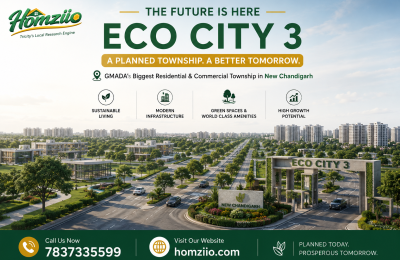
Among GMADA's most talked-about residential projects are Eco City1, Eco City 2, Eco City 3and Eco City 4 in New Chandigarh, part of a broader vision to build self-sustaining, medium-density townships that preserve natural surroundings while still offering modern city infrastructure.
New Chandigarh's development plan itself was designed on a grid-iron pattern, with major arterial roads sixty metres wide, supported by collector roads at forty-five metres and primary roads at thirty metres, ensuring the area never feels congested even as it grows.
Eco City 3and Eco City 4has been one of the more active land pooling schemesrecently, with public notices around plot size options and landowner forms circulating through 2025 and into 2026 and land acquisition for the scheme reported complete by December 2025.
For homebuyers, Eco City townships appeal because they combine GMADA's planning discipline with genuinely green, low-density living, a rare combination this close to Chandigarh.
Aerocity and Aerotropolis Mohali: The 5,500-Acre Township Near the Airport
Moving on to GMADA’s further move to develop Mohali; If there is one project capturing the imagination of investors across the Tricity real estate market right now, it is GMADA Aerocityand its much larger sibling, GMADA Aerotropolis Mohali. Aerotropolis is being developed as an extension of Aerocity, spread across roughly 5,500 acres along both sides of the Zirakpur-Banur road, close to Shaheed Bhagat Singh International Airport which is known as Mohali Airport Road, making it Mohali's answer to the aerotropolismodel of airport-led urban growth.
The township has been divided into nine pockets, labelled A through I, with the first development phase focused on pockets A, B, C and D. Phase one alone covers around 1,650 acres and GMADA has already issued work orders worth roughly ₹509 crore for internal roads and essential infrastructure across pockets B, C and D, awarded to the SBEIPL-HRG joint venture, with a completion target around April 2026.
Detail
Figure
Total planned area
Approximately 5,500 acres
Number of pockets
9, labelled Pocket A to Pocket I
Phase 1 area
Approximately 1,650 acres
Pockets B, C, D (Phase 1)
927 acres
Road infrastructure tender
Approximately ₹509 crore
Development JV
SBEIPL-HRG (Joint Venture)
Location
Near Shaheed Bhagat Singh International Airport, Zirakpur-Banur Road
Target completion (Phase 1 roads)
Around April 2026
Under the Land Pooling Policy, landowners whose farmland was acquired forAerotropolisreceive developed residential or commercial plots in proportion to the land they contributed from the GMADA approved plots,with the remaining plots going into GMADA's inventory for public allotment through e-auctionor draw. This model has become GMADA's preferred way of acquiring large tracts of land, since it keeps farmers invested in the project's success rather than treating them as a one-time transaction.
GMADA Land Pooling Scheme: A Fairer Way to Build Cities
Traditional land acquisition often left farmers with a lump-sum cash payment and no real stake in what got built on their land afterward. The GMADA land pooling schemeflips that model. Landowners voluntarily pool their agricultural land into a project and in return, they receive a share of the developed, infrastructure-ready plots once the township is complete, instead of just a cheque.
This approach has powered some of GMADA's biggest recent projects, including Aerotropolisand Eco City 3and it has become the template for how the authority plans to acquire land for future schemes across Kurali and Gharuan as well.
It is not without its complications; disputes over exact compensation ratios and delayed possession have made headlines before, but as a policy framework, it is widely seen as fairer to the original landowners than blanket acquisition.
GMADA New Chandigarh: The Township Redefining the Skyline
New Chandigarh, sometimes called Mullanpur, has become one of GMADA's flagship development zones, home to Eco City, Medi City, Edu City and Knowledge City. The area was conceived as a low-density, high-green extension of Chandigarh's planning philosophy and it continues to attract both end-users and investors who want proximity to Chandigarh without its space constraints.
Upcoming GMADA Master Plans: Kurali and Gharuan
Beyond the established zones, GMADA has been actively working on newer development corridors, particularly around Kurali and Gharuan. The GMADA Master Plan Kuraliis designed around the town's strategic position on key road corridors, with GMADA planning residential and mixed-use sectors that tap into Kurali's connectivity toward Ludhiana and Ropar. Similarly, the GMADA Gharuan development plan is being shaped by the town's proximity to major educational institutions and its position along the New Chandigarh growth corridor. As New Chandigarhhas become the Smart City of Punjab since GMADA’s development plan.
These upcoming zones matter for one simple reason: early investors in GMADA's earlier townships like Aerocity and Eco City 1 have historically seen strong appreciation once infrastructure caught up with the master plan. Kurali and Gharuan are being watched closely for the same pattern to repeat.
Zirakpur, Kharar and Derabassi: GMADA's Other Growth Engines
While Aerocity and Eco City dominate headlines, GMADA's Zirakpur, Kharar and Derabassi projects quietly do a lot of heavy lifting for Tricity's housing demand. These towns sit on major highway corridors connecting Chandigarh, Panchkula and Ambala, making them attractive for both residential buyers and commercial investors who want lower entry prices than core Mohali sectors while still staying within GMADA's planned jurisdiction.
Mohali Sector-Wise Plots and the Tricity Real Estate Story
Mohali's core sectors, roughly numbered from Sector 48 through Sector 91 and beyond, form the backbone of GMADA's original master plan. Each sector was designed with its own mix of residential plots, parks, community sites and commercial belts, which is why Mohali's older sectors today feel noticeably more organised than many privately developed colonies nearby.
This planned character is a big reason why Tricity real estate, spanning Chandigarh, Mohali and Panchkula, has held its value so consistently. Chandigarh has almost no fresh land left to allot, which pushes demand naturally toward Mohali's GMADA sectors and, increasingly, toward Zirakpur, Kharar and now Aerotropolis.
How to Buy a Plot From GMADA: The E-Auction Process, Step by Step
Gone are the days of standing in long queues outside government offices. GMADA plot allotments now largely move through a structured online e-auction process. Here is how it typically works.
Registration:Interested buyers register on GMADA's official e-auction portal and complete KYC verification with valid identity and address proof.
Earnest Money Deposit: Bidders deposit a specified earnest money amount, usually a percentage of the reserve price, to qualify for bidding on a chosen plot.
Reserve Price Disclosure: Every plot is listed with its official reserve price, category, size and location, so bidders know the minimum threshold before placing a bid.
Bidding Window: The auction runs over a fixed window, often two to four weeks, during which registered bidders place incremental bids online.
Result Declaration: Once bidding closes, GMADA declares the highest valid bidder for each site and issues a provisional allotment.
Payment and Allotment Letter: The successful bidder pays the balance amount as per the payment schedule, after which GMADA issues a formal allotment letter.
Conveyance Deed: Once all dues are cleared and infrastructure conditions are met, GMADA executes the conveyance deed, transferring full legal ownership.
Latest GMADA Schemes in 2026
2026 has already been an eventful year for GMADA. The authority opened its first mega e-auction of the year from 14 January to 11 February, later extended to early March due to technical issues faced by some applicants, offering 42 prime sites, a mix of residential, commercial, institutional and mixed-use plots, with a combined reserve value of roughly ₹5,460 crore. Commercial SCO and retail sites in this auction carried reserve prices starting from around ₹3 lakh per square metre.
Punjab's Housing and Urban Development Minister described the pricing in this auction as rationalised, aimed at making GMADA properties accessible to a wider section of buyers rather than only large institutional investors.
Around the same period, Mohali's collector rates were revised upward by roughly 20 to 22 percent in October 2025, a reminder that land values in this belt continue climbing steadily even as new supply enters the market through Aerotropolis and Eco City 3.
Date
Development
October 2025
Mohali collector rates revised upward by approximately 20-22 percent
December 2025
Eco City 3 land acquisition reported complete
14 Jan - 11 Feb 2026 (extended to March)
First mega e-auction of 2026: 42 sites, ~₹5,460 crore reserve value
June 2026
Eco City 4 Section 4(1) notification issued
Why GMADA Properties Continue to Attract Serious Buyers
At the end of the day, people are not just buying square yards of land, they are buying certainty. A GMADA plot comes with a documented history, from the notification that acquired the land, to the master plan that zoned it, to the e-auction that allotted it.
That paper trail is worth more than most buyers realise until the day they try to sell or mortgage a property and discover how much smoother it is when every document lines up.
Whether it is a young professional eyeing a compact plot in Kharar, a family saving up for a Mohali sector home or an NRI investor drawn to the scale of Aerotropolis near the airport, GMADA's blend of planned infrastructure, transparent allotment and legal safeguards keeps pulling buyers back to its schemes year after year.
Conclusion: Why GMADA Still Matters to Every Tricity Homebuyer
GMADA was never just another government office issuing paperwork. From its formation in 2006 under the Punjab Regional and Town Planning and Development Act to its current role shaping Aerotropolis, Eco City 3and the upcoming Kurali and Gharuan master plans, GMADA has been the quiet architect behind Mohali's transformation from farmland into one of North India's most sought-after real estate markets. Every sector road, every planned park and every verified conveyance deed traces back to decisions GMADA made years, sometimes decades, in advance.
For anyone comparing PUDAvs GMADA, weighing freehold vs leasehold options or simply trying to understand how GMADA works before committing their savings, the underlying message stays the same: GMADA's structured, transparent process exists specifically to protect you. That protection, built plot by plot and sector by sector since 2006, is exactly why GMADA continues to be the name Tricity families trust when it is finally time to buy.
Sources: Official GMADAand PUDAgovernment portals (gmada.gov.in, puda.gov.in), Punjab Government notifications and verified 2025-2026 news reporting on GMADA schemes and auctions. Pricing and scheme details are subject to change; buyers should always confirm current figures on GMADA's official e-auction portal before making any payment.
Rozen Singgla is a real estate analyst and co-founder of Homziio, specialising in the Chandigarh Tricity property market. With deep expertise in RERA-verified residential and commercial projects across Mohali, Zirakpur, Kharar, and Panchkula, Rozen helps buyers and investors make informed decisions backed by verified data and on-ground market insights.









 Jul 17, 2026
 Jul 16, 2026
 Jul 15, 2026