

Land Pooling Scheme Punjab 2026: The Complete GMADA Land Pooling Guide for Mohali Landowners and Investors

Punjab's real estate landscape is going through a quiet revolution and at the heart of it lies the Land Pooling Scheme Punjab, a policy that is changing the way farmland becomes future-ready urban space. If you have been hearing whispers about the Land Pooling Scheme Punjab in Mohali's tea stalls, WhatsApp groups or panchayat meetings, you are not imagining things.
The GMADA Land Pooling Scheme has moved through three major revisions in just twelve months and the version notified in July 2026 is already being called the most generous one yet. For farmers, investors and homebuyers alike, understanding the Land Pooling Scheme Punjab could mean the difference between missing an opportunity and securing a life-changing asset.
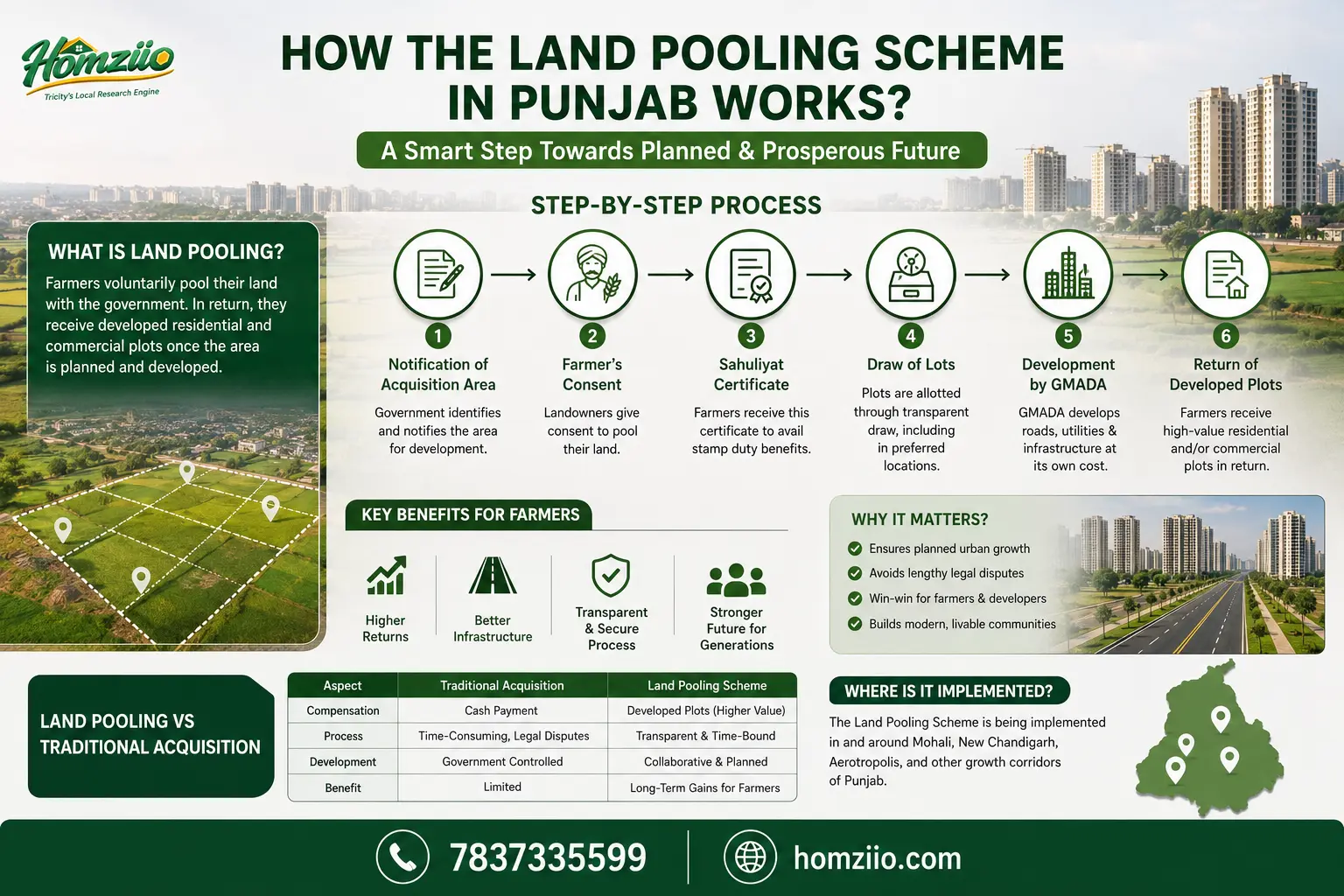
What Is the Land Pooling Scheme in Mohali, Punjab?
At its simplest, land pooling is an alternative to straight cash compensation. Instead of the government acquiring a farmer's field and handing over a one-time cash award. The landowner pools that land with the Greater Mohali Area Development Authority and, in return, receives fully developed urban plots, residential, commercial or both, once the township comes up around it.
The idea was first notified as the Land Pooling Policy 2008,but it truly entered public conversation in June 2025, when the government proposed pooling over 65,000 acres statewide on a compulsory basis.
Farmers pushed back hard, the Punjab and Haryana High Court stepped in with an interim stay and by August 2025 the policy was withdrawn altogether. What came next, in November 2025, was a softer, optional version and Punjab has been fine-tuning it ever since.
Land Pooling: How a Century-Old Planning Idea is Shaping Modern Cities
Land pooling is not a new idea. It first came to India through the Bombay Town Planning Act of 1915, which let local authorities pool small, scattered plots into one large parcel, plan roads and public spaces, and return developed plots to the original owners.
Gujarat built on this model with its Town Planning and Urban Development Act of 1976 and over the decades states like Maharashtra, Punjab and Andhra Pradesh adopted similar systems.
Unlike land acquisition, which often meant forced takeovers, land pooling worked on partnership. Owners kept a share of their land, now planned and serviced, instead of losing it altogether. This approach has become the foundation for many of India's newer urban development schemes, including those shaping fast-growing regions like New Chandigarh today.
The Land Pooling Policy in Punjab came into existence in 2025.
The Punjab government, under Chief Minister Bhagwant Mann, formally notified the Land Pooling Policy-2025 on June 4, 2025. It aimed to promote planned urban development across the state by allowing landowners, especially farmers, to voluntarily pool their agricultural land in exchange for developed residential and commercial plots instead of cash compensation. Initially introduced as a compulsory scheme for large-scale acquisition, it faced strong farmer protests and a High Court stay, leading to its withdrawal in August 2025. The policy was later revised in November 2025 to make it fully voluntary. Subsequent amendments in 2026 further enhanced benefits for landowners.
Why GMADA Insists on 100% Land Before Any Development Begins
GMADAhas kept one condition firm from the start: development work begins only after 100% of the land in a sector is pooled. Nothing less. This is not red tape. It comes from years of hard experience. In the older acquisition model, disputes over land value and ownership often ended up in court, sometimes dragging on for years, holding up entire projects and leaving both farmers and buyers stuck in limbo.
Land pooling was GMADA's answer to that problem. By requiring full participation before a single road or pipeline is laid, the authority avoids fragmented development and future legal battles. There's another reassurance built into this model: GMADA bears all development costs itself, including roads, sewerage, water supply, and electricity infrastructure.
Landowners don't need to pay for the transformation of their own land. This is what makes the scheme fair for farmers and dependable for investors. It removes the guesswork, protects everyone's interest, and ensures that once a sector is announced, development actually follows through, sector by sector, without court delays or half-finished infrastructure.
GMADA Land Pooling Scheme: A Win-Win for Farmers and Developers
The GMADA Land Pooling Scheme is an innovative urban development approach in which farmers voluntarily combine their land for organized, planned development. In exchange, they receive back developed plots with significantly higher value and modern infrastructure. This model delivers higher returns to farmers while providing private developers with ready-to-build land free of acquisition hurdles, thereby speeding up high-quality real estate growth in Greater Mohali.
How Does the GMADA Land Pooling Policy Work for Farmers?
Here is the honest, on-ground version of how it plays out for a family in a village near New Chandigarh or the Aerotropolis belt.
- The government notifies an acquisition area, usually covering thousands of acres across several villages.
- Each landowner receives a Letter of Intent and is free to choose between cash compensation or developed plots - this choice was made optional after the 2025 backlash.
- Farmers who opt for pooling are issued a Sahuliyat Certificate, the facilitation document that unlocks stamp duty benefits.
- Plots are allotted through a transparent draw of lots, including plots in preferred locations that were earlier kept aside by GMADA.
- Village panchayat land acquisition proceedings run alongside individual consent and in the current phase a majority of village panchayats have actually endorsed the acquisition, a sign that trust is slowly being rebuilt.
Three major compensation awards worth roughly Rs 6,069 crore have already been declared across 1,231 acres, covering Eco City 3, the Aerotropolis blocks and the low and high density township - proof that this is not a policy sitting on paper, it is money and land changing hands right now.
A Quick Timeline: How Punjab's Land Pooling Policy Reached Version 3.0
Understanding today's benefits is easier once you see the road that led here.
- January 5, 2021: The original Land Pooling Policy 2020 is formally notified.
- June 4, 2025: A sweeping, compulsory version proposing 65,533 acres statewide is notified, triggering farmer protests within days.
- August 2025: Facing a High Court stay and mounting political pressure from opposition parties, the government withdraws the policy entirely.
- November 21, 2025: A revised, optional policy returns, letting farmers choose between cash and developed plots for the first time.
- April 2026: After a three-week Pucca Morcha outside GMADA's office, the government agrees in principle to enhance plot sizes, extend the Sahuliyat Certificate and add oustee benefits for all farmers.
- July 1–6, 2026: The Council of Ministers approves the enhancements and the third and current edition of the policy is formally notified.
This back-and-forth is exactly why relying on outdated blogs or word of mouth is risky - a figure that was accurate in November 2025 may already be outdated today, which is why every landowner and investor should always verify current entitlements directly with GMADA before making a decision.
Land Pooling vs Land Acquisition: What Is Actually Different
People often use these terms interchangeably, but for a farmer standing at the crossroads, the difference is life-altering.
Parameter | Land Acquisition (Traditional) | Land Pooling Scheme Punjab |
|---|---|---|
Compensation | One-time cash award at declared rate | Choice of cash OR developed residential/commercial plots |
Ownership stake | None after payment | Farmer becomes co-owner of the future township |
Stamp duty | Not applicable | Exemption via Sahuliyat Certificate (2 options) |
Long-term value | Fixed, does not grow with development | Rises with the township, up to ~Rs 16 crore/acre value |
Farmer consent | Compulsory | Optional since November 2025 revision |
Latest Amendment to Punjab Land Pooling Policy 2026
Punjab has rewritten this policy three times in twelve months and the July 2026 version, approved by the Council of Ministers on July 1 and formally notified on July 6, is the most farmer-friendly edition so far.
It amends the original 2021 policy and its November 2025 revision and it arrived after a three-week Pucca Morcha, a permanent sit-in and hunger strike outside the GMADA office in Mohali, forced the government back to the negotiating table.
Chief Minister Bhagwant Mann personally reiterated his government's commitment to making farmers equal partners in Punjab's growth story and the numbers back that intent.
Key highlights of Land pooling scheme punjab 3.0:
- Two clear stamp duty options: zero duty on the conveyance deed itself or a full exemption when buying alternative land anywhere in Punjab.
- Sahuliyat Certificate validity doubled from two years to four years.
- Priority tubewell connections extended to a four-year window, with PSPCL directed to install on priority.
- All developed plots, including preferential location plots that GMADA used to hold back, now go into the open draw of lots.
- A binding three-year deadline for completing development works, plus a fresh assessment policy for orchards and structures on acquired land.
- A first-of-its-kind commitment to develop the villages themselves alongside the townships, with schools, parks and dispensaries kept out of acquisition and village sewerage, water and roads linked into GMADA's own systems.
Residential Plot Entitlement Per Acre 2026: The Numbers That Matter
Category | Earlier Entitlement | 2026 Entitlement | Applicable On |
|---|---|---|---|
Residential (per acre) | 1,600 sq yd | 1,630 sq yd | 1 acre & above |
Commercial SCO (mixed use) | 200 sq yd | 210 sq yd | 1 acre & above |
Standalone commercial category | 800 sq yd | 840 sq yd | 1 acre & above |
Oustee quota – up to 0.5 acre | Plot-opting farmers only | 200 sq yd, scheme price | All farmers, incl. cash |
Oustee quota – 0.5 to 2.5 acre | Plot-opting farmers only | 300 sq yd, scheme price | All farmers, incl. cash |
Oustee quota – above 2.5 acre | Plot-opting farmers only | 500 sq yd, scheme price | All farmers, incl. cash |
For context on value, agricultural land in the GMADA belt was worth close to Rs 5 crore per acre before acquisition notifications went out. Once notified, market value climbed to roughly Rs 8 crore per acre. The combined market value of the developed plots a farmer eventually receives under the Land Pooling Policy Mohaliis estimated at nearly Rs 16 crore per acre - more than double the post-notification price and about three times the original farmland value, provided, of course, that development actually happens on schedule.
Sahuliyat Certificate GMADA and Stamp Duty Exemption Punjab Land
The Sahuliyat Certificate is arguably the most practical benefit in the entire scheme and yet it is the one least understood by first-time landowners. It is a facilitation certificate issued to farmers who accept compensation and it opens the door to a genuine stamp duty exemption Punjab land buyers rarely get elsewhere.
Under the 2026 amendment, a farmer can either register the conveyance deed on the pooled land at zero stamp duty or use the certificate to buy replacement land anywhere in the state without paying stamp duty, calculated on the collector rate of the acquired land.
The certificate window has been stretched from two years to four, giving families breathing room instead of forcing rushed decisions within months of losing their fields.
Bhagwant Mann Land Policy: The Vision Behind the Numbers
Every policy document eventually reduces to numbers on a page, but behind the Bhagwant Mann land policy is a genuinely emotional story - farmers who have tilled the same soil for generations being asked to trust that a government promise made today will still hold value five years from now.
The scars of unfinished projects, the Aerotropolis itself was conceived back in 2016 and parts of it remain unbuilt, making that trust hard to earn. The Pucca Morcha outside GMADA's Sector 62 office in Mohali was not just a protest, it was families camping in the open, demanding dignity alongside development. That the government responded with bigger plots, a doubled certificate window and oustee benefits for every affected farmer, cash compensees included, shows a policy shaped as much by ground pressure as by planning.
Why This Matters for Buyers, Investors and Families Alike
For homebuyers and investors watching Mohali's skyline grow, the Land Pooling Scheme Punjab is quietly reshaping the supply pipeline of future residential and commercial plots. Every acre that moves through this scheme eventually becomes a sector, a society or a commercial hub, which means the plots being allotted to farmers today could well be the addresses buyers are searching for two or three years from now. Investors who understand these entitlement numbers early are simply better positioned when developed sectors finally open for sale.
Since 2004, Homziiohas stood alongside builders, investors and buyers across Punjab's most trusted developments and a policy shift of this scale is one every serious property decision should account for. With more than 500 completedand ongoing projects and direct working relationships across the investor and builder ecosystem, Homziio tracks these regulatory shifts closely so our readers do not have to sift through dense legal notifications alone. We believe a farmer deciding the future of ancestral land deserves the same clarity as a buyer signing on a new plot and that is the spirit behind every update we publish.
Conclusion of Punjab land pooling scheme 3.0
The Land Pooling Scheme Punjabis no longer paperwork tucked away in government files, it is quietly turning generations of farming families into stakeholders of tomorrow's cities. Whether you are a farmer weighing your options under the Land Pooling Scheme Punjab, an investor tracking the GMADA Land Pooling Scheme or a homebuyer eyeing plots shaped by the Land Pooling Policy Mohali, the ground beneath Mohali is shifting for the better. As the Land Pooling Scheme Punjab enters its most generous phase yet, one thing is clear: the Land Pooling Scheme Punjab is rewriting the relationship between farmland and the future. Homziiowill keep bringing you verified, on-ground updates on every twist of this policy, so you never miss a plot, a deadline or an opportunity.






Rozen Singgla is a real estate analyst and co-founder of Homziio, specialising in the Chandigarh Tricity property market. With deep expertise in RERA-verified residential and commercial projects across Mohali, Zirakpur, Kharar, and Panchkula, Rozen helps buyers and investors make informed decisions backed by verified data and on-ground market insights.

News insight
 Sep 04, 2026
GMI Infra Group: The Real Story Behind the City's Tallest Tower
GMI Infra Group started as a jewellery business in Chandigarh and grew into a well-known real estate...
 Aug 21, 2026
Real Estate in Zirakpur: The Complete 2026 Guide to Property, Prices and Smart Investment
Real Estate Zirakpur has grown from a Chandigarh stopover into a thriving Tricity destination. This...
 Aug 13, 2026
GB Realty 5000 Crore Investment Set to Power North India's Next Luxury Housing Boom
GB Realty is investing Rs 5,000 crore over 3 years and Rs 10,000 crore over 5 to expand luxury housi...