
Punjab Scraps 2025 Building Rules

What the Return to 2018 Bylaws and 2021 Development Norms Means for Homeowners, Builders and Urban Planning
The Punjab government has officially withdrawn its controversial Punjab Building Rules, 2025, ending months of legal battles, public outcry, and administrative gridlock. Going forward, all construction activity across Punjab - from a single-storey extension in Ludhiana to a commercial complex in Amritsar - will be governed by two pre-existing frameworks: "The Punjab Municipal Building Bylaws, 2018" and the "Punjab Urban Planning and Development Building Rules, 2021". For anyone planning to build, buy or invest in property across the state, this shift carries significant implications.
As per news published in - The Indian Express
Why Were the 2025 Rules Scrapped? The Legal and Public Pressure That Forced the Rollback
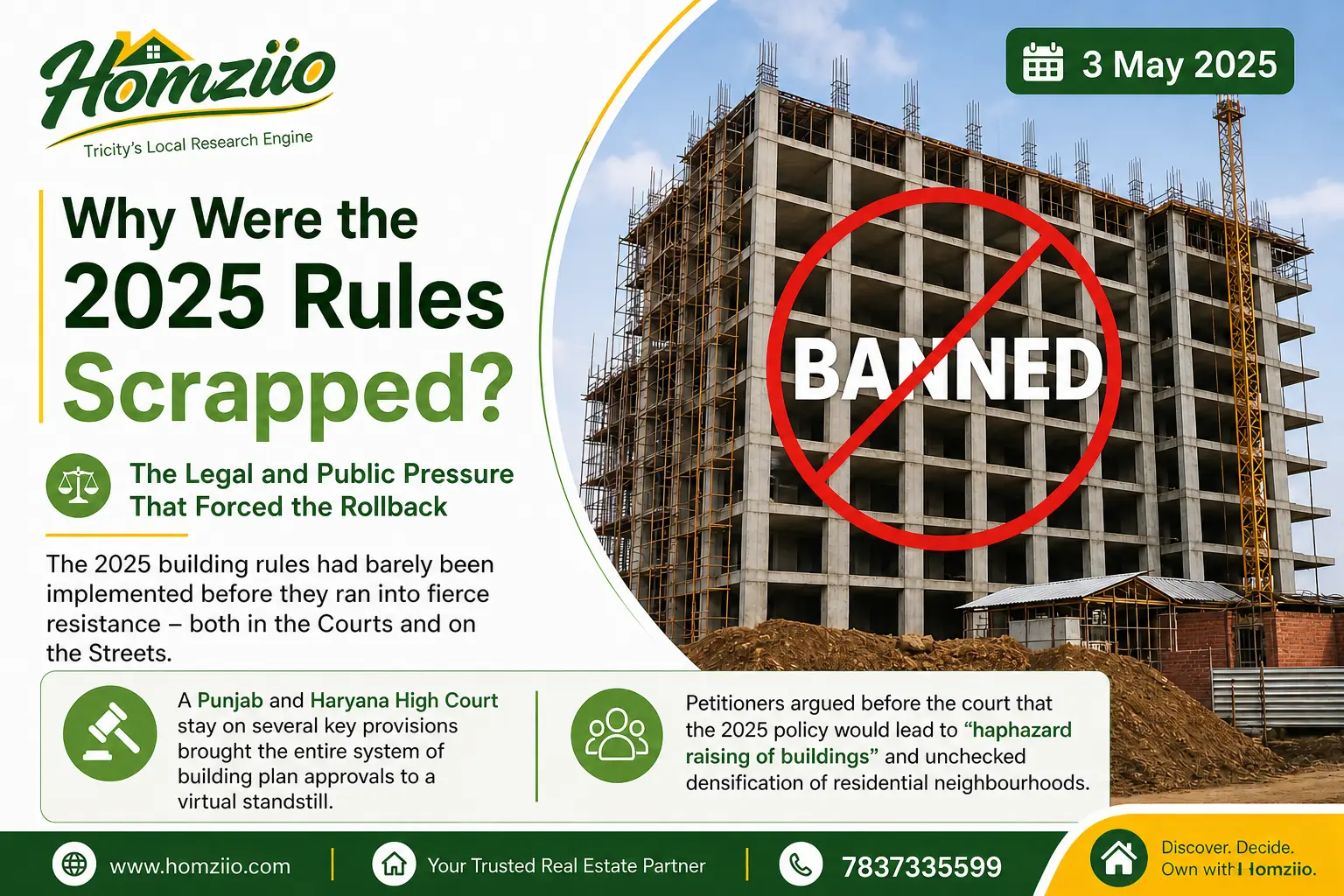
The 2025 building rules had barely been implemented before they ran into fierce resistance - both in the Courts and on the Streets.
A Punjab and Haryana High Court stay on several key provisions brought the entire system of building plan approvals to a virtual standstill. A senior government functionary confirmed that "public-related work pertaining to the approval of building plans, compounding of violations and allied matters had virtually come to a standstill, leading to delays and inconvenience to applicants. This situation became unsustainable and unacceptable for both the public (homebuyers, investors) and the government, as it caused financial stress, delays and lack of development.
Beyond the legal tangle, the rules faced a fundamental crisis of public trust. Petitioners, including 93-year-old Harbinder Singh Sekhon and 61-year-old Jasinder Sekhon, argued before the court that the 2025 policy would lead to "haphazard raising of buildings" and unchecked densification of residential neighborhoods. Their petition gave a human face to what urban planners had been warning about in technical reports for months.
What the 2025 Rules Actually Proposed -And Why Critics Called Them Dangerous
To understand why the rollback matters, it is important to examine what the 2025 rules were trying to do and what they got wrong.
The Core Intent: Revenue and Growth
At heart, the 2025 policy was an attempt to streamline construction approvals and stimulate real estate growth. Its revenue model was tied to collector rates - meaning the government stood to earn more by permitting larger, taller buildings and charging accordingly.
The Contentious Provisions- Several specific provisions drew sharp criticism:
- Stilt-plus-four-floor constructions were to be permitted, dramatically increasing vertical density across Punjab's cities.
- Higher ground coverage was allowed, meaning buildings could occupy a greater percentage of a plot's area, leaving less open space.
- Increased Floor Area Ratio (FAR) allowed more built-up space relative to the plot size, effectively packing more construction into the same footprint.
- Stilt-plus-four buildings on 40-foot-wide roads- a provision considered alarming by fire safety experts, as narrow roads limit emergency vehicle access.
- Up to 100% ground coverage for commercial buildings in core urban areas- meaning zero setbacks, zero green space and maximum structural density.
A Real-World Comparison: The Dharavi Redevelopment Lesson
Consider what happened in parts of dense urban Mumbai, where high ground coverage in older commercial zones led to a complete absence of natural light, ventilation, and emergency access. Fire departments have documented multiple instances where narrow lanes and 100% coverage buildings made it impossible to deploy equipment during emergencies. Punjab's 2025 rules risked replicating precisely this problem in cities like Jalandhar and Patiala - cities that already struggle with traffic congestion and ageing water infrastructure.
The Infrastructure Warning Nobody Wanted to Hear
Urban planners and environmentalists were united in their concern: Punjab's civic infrastructure is simply not built to absorb the density that the 2025 rules would have generated.
Key Infrastructure Risks Flagged
Fire safety preparedness: Taller, denser buildings demand more fire stations, better-equipped fire tenders, and wider access roads. Punjab's fire infrastructure has not kept pace with even current urban growth.
Traffic congestion: Allowing stilt-plus-four constructions on 40-foot roads would multiply the number of residents and vehicles in areas already struggling with daily gridlock. Think of sectors in Mohali where peak-hour traffic on internal roads already causes 20–30 minute delays over distances of under two kilometres.
Groundwater stress: Higher ground coverage means less permeable surface area. In cities like Ludhiana, where the water table has already dropped alarmingly due to over-extraction and poor recharge, reducing open ground further could accelerate a genuine water crisis.
Drainage overload: More built-up area generating more runoff into a drainage system designed for much lower loads is a formula for flooding - as any resident of Chandigarh's peripheral sectors can attest after a heavy monsoon.
Who Was Behind the 2025 Rules? The Developer Dominance Controversy
One of the most pointed objections raised before the High Court concerned the composition of the Real Estate Advisory Committee that drafted the 2025 policy.
Petitioners alleged that the committee was dominated by private developers and promoters with vested interests, effectively sidelining public concerns in favour of commercial gains. Citizens and resident welfare associations claimed they were not adequately consulted during the formulation of the policy -a grievance that resonates with similar controversies seen in other states.
A Parallel from Bengaluru
When Bengaluru revised its zoning rules in 2015 to allow higher FAR in certain corridors, the process was similarly opaque. Within three years, several residential neighbourhoods near commercial zones - particularly around Marathahalli and Whitefield - experienced parking shortages, sewage overflow, and power supply failures as infrastructure buckled under the weight of unchecked densification. The lesson? When developers write the rules without adequate public oversight, it is residents who pay the long-term price.
What Happens Now: Back to the 2018 Bylaws and 2021 Development Rules
With the 2025 rules scrapped, two frameworks resume authority over construction in Punjab.
Punjab Municipal Building Bylaws, 2018
These bylaws govern construction within the jurisdictions of Punjab's municipal bodies - from municipal corporations in major cities to smaller municipal councils and nagar panchayats. They define:
- Permissible building heights based on road width and plot area
- Setback requirements- the mandatory open spaces that must be maintained on each side of a building
- Ground coverage limits that ensure adequate ventilation and light
- Parking standards scaled to building use and sizeSafety requirements including structural stability, fire exits and staircase dimensions
Punjab Urban Planning and Development Building Rules, 2021
These rules apply in areas under the Punjab Urban Planning and Development Authority (PUDA) and similar planned development zones. They are generally considered more forward-looking, incorporating provisions for:
- Mixed-use zoning that balances residential, commercial, and institutional uses
- Green building incentives tied to energy efficiency and water conservation
- Stricter fire safety norms in high-rise developments
- Transit-oriented development principles encouraging walkable, well-connected neighbourhoods
Practical Impact for Property Owners and Builders
If you are currently seeking approval for a building plan in Punjab, here is what the return to the 2018/2021 framework means in practice:
- Building approvals are processing again. The administrative logjam caused by the High Court's stay is over.
- Stilt-plus-four constructions are no longer a universal right. Height permissions revert to road-width-linked standards under the older rules.
- Ground coverage limits are restored. The 100% coverage provision for commercial buildings in core areas is off the table.
- Compounding of violations- the process by which builders regularise deviations from sanctioned plans- resumes under the older, more tested framework.
What This Means for Punjab's Real Estate Market
The scrapping of the 2025 rules will have mixed effects on Punjab's property sector.
For buyers, particularly in residential neighborhoods, the news is broadly positive. The older rules preserve lower density, more open space and safer building heights - protecting quality of life and potentially supporting long-term property values.
For developers, the mood is less confident. The 2025 rules had opened up significant commercial opportunities through higher FAR and ground coverage. Many projects - particularly high-density housing schemes and commercial complexes - may need to be redesigned to fit within the older framework's parameters.
For investors, the situation calls for careful due diligence. Projects approved or marketed under the assumption that 2025 norms would remain in force may now face revised viability calculations.
The Gurugram Counterexample
Haryana's Gurugram offers an instructive contrast. When high FAR permissions were liberally granted there in the mid-2000s without corresponding upgrades to water supply, sewage treatment and road networks, the result was a decade of infrastructure crisis that the city is still recovering from. Punjab has, at least for now, stepped back from a similar trajectory.
The Road Ahead: What Punjab's Urban Policy Needs
The scrapping of the 2025 rules is not an ending - it is a reset. Punjab's cities are growing and building policy will need to evolve. But the manner of that evolution matters enormously.
Urban planners, environmental advocates and citizen groups have consistently called for:
- Transparent, inclusive policy formulation that gives resident associations, environmental experts, and independent urban planners a genuine seat at the table - not just developers and promoters.
- Infrastructure-first sequencing: FAR and ground coverage increases should only be permitted in areas where water supply, sewage treatment, roads and fire services have the capacity to support higher density.
- District-specific norms that reflect the vastly different contexts of a rapidly urbanising Mohali and a smaller heritage city like Patiala.
- Environmental impact assessments as a mandatory precondition for any future relaxation of ground coverage or height limits.
- Digital transparency in the approval process - a single online portal for building plan submissions, tracking and public access to approved plans, similar to the system developed by the Pune Municipal Corporation.
Conclusion
The rollback of Punjab's 2025 Building Rules is a clear signal that urban policy cannot be drafted in isolation - without consulting the people who will live with its consequences, without stress-testing it against existing infrastructure and without independent oversight of the interests driving the agenda. The return to the 2018 Bylaws and 2021 Development Rules restores a measure of order and predictability to Punjab's construction sector. But the deeper question - how to accommodate urban growth without sacrificing livability- remains very much open. The answer will require not just new rules, but a genuinely different approach to how those rules are made.







Rozen Singgla is a real estate analyst and co-founder of Homziio, specialising in the Chandigarh Tricity property market. With deep expertise in RERA-verified residential and commercial projects across Mohali, Zirakpur, Kharar, and Panchkula, Rozen helps buyers and investors make informed decisions backed by verified data and on-ground market insights.
News insight
 Oct 06, 2026
 Ready-to-Move vs Under-Construction Flats in Tricity: Mohali, Zirakpur, Kharar, New Chandigarh & Panchkula
Ready-to-move vs under-construction flats: which one suits you? A ready flat gives quick possession,...
 Sep 15, 2026
 Real Estate in Kharar Guide 2026: Complete Buyer's Handbook
Discover why real estate in Kharar is booming in 2026 verified prices, RERA-approved projects, top i...
 Sep 04, 2026
 GMI Infra Group: The Real Story Behind the City's Tallest Tower
GMI Infra Group started as a jewellery business in Chandigarh and grew into a well-known real estate...