
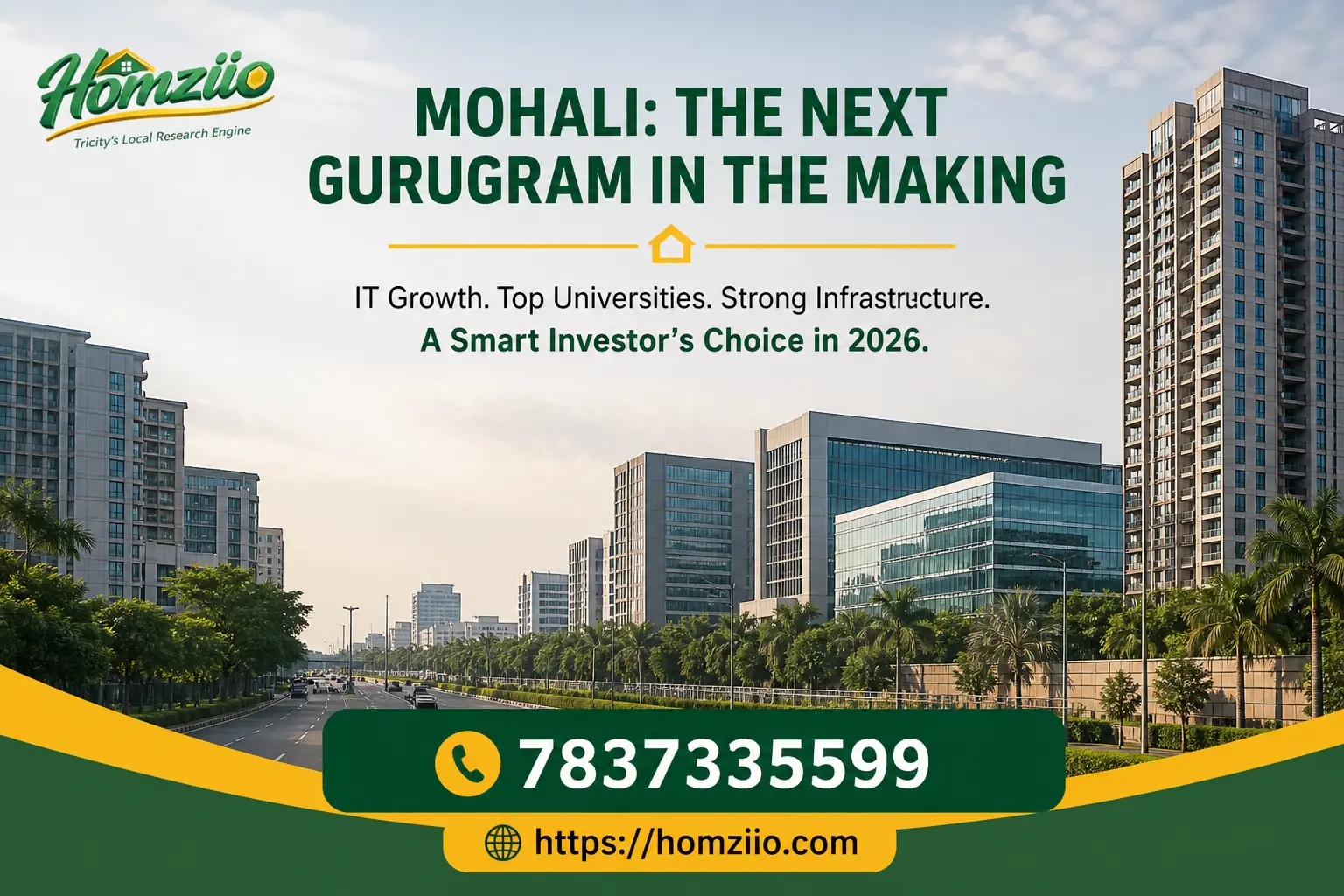
Mohali: The Next Gurugram? Here's Why North India's Fastest-Growing City Is the Smartest Investment Right Now
-
- IT City Mohali: The Engine Behind the Transformation
- World-Class Universities Fuelling Long-Term Demand
- Infrastructure That Is Built to Last
- NHAI & Bharatmala Project: Connecting Mohali to Major Metro Cities
- Mohali: North India's Emerging Medical Hub
- Mohali: A City With Soul
- Real Estate: Where the Numbers Tell the Story
For years, Gurugram was just a quiet town on the outskirts of Delhi. Then came the IT companies, the expressways, the corporate campuses - and suddenly, it became one of India's most powerful real estate and business destinations. Property prices that once seemed unreasonably high turned into some of the best returns investors had ever seen.
Today, a very similar story is unfolding just 250 kilometres to the north - in Mohali.
Once considered simply an extension of Chandigarh, Mohali is now drawing serious attention from investors, homebuyers, and businesses across the country. The infrastructure is growing. The IT sector is expanding. Top universities are setting up campuses. And real estate prices are beginning to climb - but they are still at a stage where early movers can benefit the most.
If you missed Gurugram in 2005, Mohali in 2026 might just be your second chance.
Why Everyone Is Comparing Mohali to Gurugram
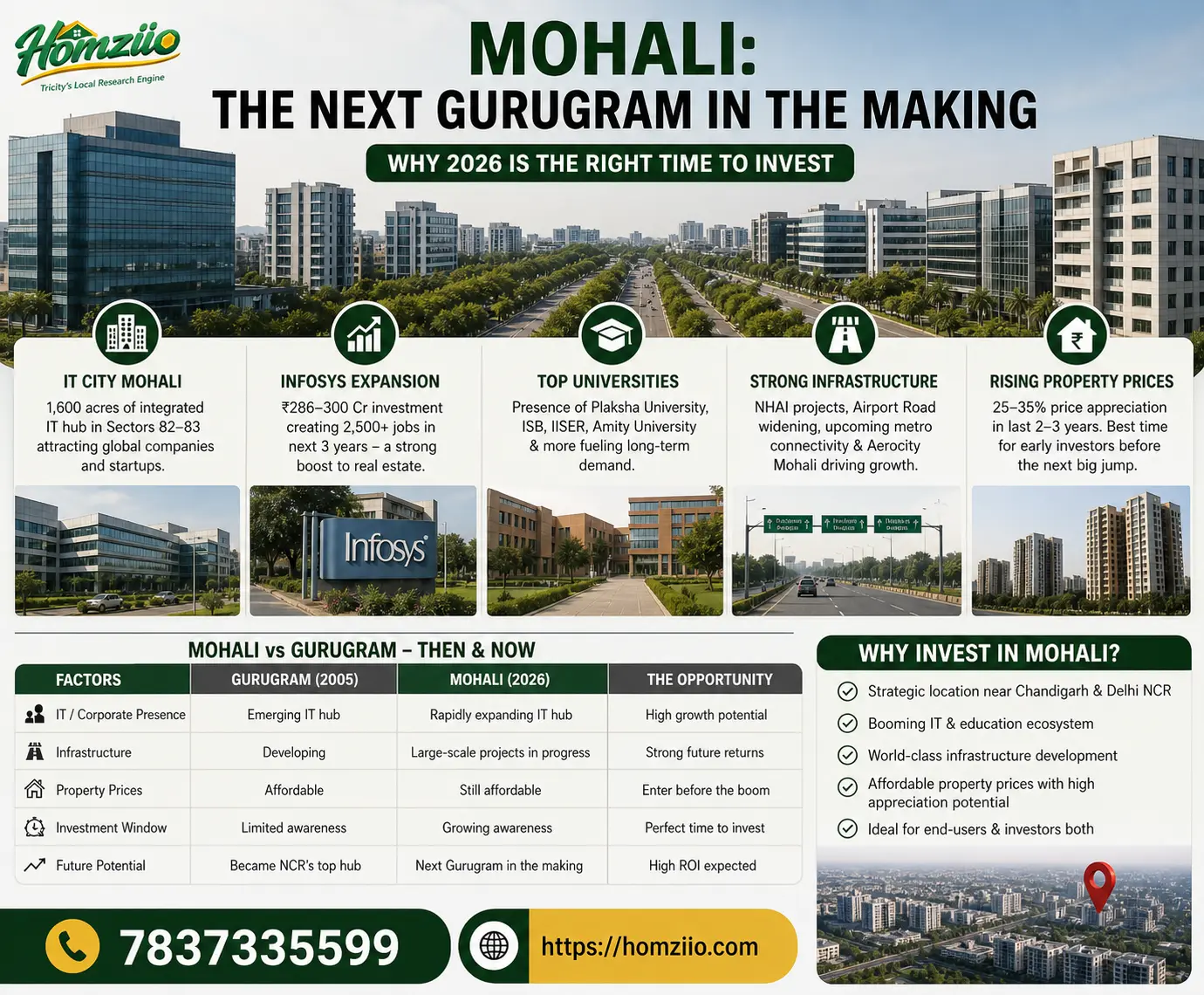
The comparison between Mohali and Gurugram is not just a marketing slogan. It is grounded in clear, measurable similarities in how both cities have grown - and continue to grow.
Gurugram's rise was built on three main pillars: a booming IT and corporate sector, large-scale infrastructure development and premium residential projects that attracted professionals and their families. Each of these pillars directly pushed real estate demand and property prices upward.
When you look at Mohali today, you find the exact same pillars taking shape - but at an earlier and more affordable stage. This is what makes the opportunity so significant. Mohali is not trying to become Gurugram; it is simply following the same well-proven path of urban and economic growth.
IT City Mohali: The Engine Behind the Transformation
The single biggest driver of Mohali's growth is IT City Mohali, a planned development spread across approximately 1,600 acres in Sectors 82–83. This is not a small business park - it is a full-scale urban development designed to house global IT companies, startups, corporate offices, residential zones and commercial spaces all in one integrated hub.
To understand what this means for the city, think about what Cyber City and Udyog Vihar did for Gurugram. When those business districts were developed, they became magnets for companies like Google, Deloitte and Accenture. Thousands of professionals poured into the city. Rental demand shot up. Residential projects followed. Property prices multiplied over the next decade.
IT City Mohali is designed to do the same for North India. It already houses major corporate operations, and with more companies scouting locations in the region, the footprint of this area is only going to grow.
Infosys Expansion: A Signal the Market Cannot Ignore
One of the clearest real-world signs of Mohali's growing importance is the expansion of Infosys- one of India's largest and most respected IT companies - within the city.
Infosys has committed an investment of approximately ₹286–300 crore toward expanding its Mohali campus. This expansion is expected to create between 2,500 and 2,700 new jobs in the region in the next Three years.
This is not a small development. When Infosys expanded in Pune in the early 2000s, areas around its campus - like Hinjewadi and Kharadi - saw property prices double and then triple over the following years. The same story repeated itself in Bengaluru around Electronic City and Whitefield. In both cases, early investors who recognized the pattern earned extraordinary returns.
Today, areas near IT City and Airport Road in Mohali have already seen 25–35% price appreciation over the last two to three years and the Infosys expansion has not yet reached full scale. The ripple effect on rental demand, housing requirements, and commercial activity is still building up.
World-Class Universities Fuelling Long-Term Demand
A factor that is often underestimated in real estate growth is education. When top universities establish themselves in a city, they bring in thousands of students, faculty members, researchers, and support staff - all of whom need housing, food, transport and services. This creates a steady, long-term demand that makes the local property market far more stable and attractive.
Mohali is quietly becoming one of North India's most significant education destinations.
Mohali's Education Ecosystem: A Silent Real Estate Growth Driver
Mohali is rapidly emerging as North India's most dynamic education hub. Plaksha University, with its cutting-edge focus on Artificial Intelligence, Robotics, and Advanced Technology, is attracting bright minds from across India and beyond - much like BITS Pilani and Manipal transformed their surrounding property markets. Furthermore, Amity University in Sector 82A brings thousands of students annually, creating consistent demand for housing and local services. IISER Mohali, an institution of national importance, adds a layer of academic prestige by drawing top-tier researchers and faculty to the region.
Adding further weight to this ecosystem, the Indian School of Business (ISB) Mohali is grooming future business leaders, attracting high-income professionals and executives who naturally elevate local residential and commercial demand.
Together, these institutions are building exactly the kind of young, skilled, and growing population that drove real estate booms in Pune and Hyderabad - and are now set to do the same for Mohali.
Infrastructure That Is Built to Last
Gurugram's transformation accelerated sharply after the Delhi-Gurgaon Expressway was completed, and later when Metro connectivity was introduced. These infrastructure upgrades made the city easily accessible, which in turn made it far more attractive to businesses and residents.
Mohali is going through its own version of this infrastructure leap.
NHAI & Bharatmala Project: Connecting Mohali to Major Metro Cities
Under the Bharatmala Pariyojana, NHAI is developing wider, high-speed highway corridors directly linking Mohali to Delhi, Jaipur and Ludhiana. These upgraded road networks reduce travel time significantly, boost logistics efficiency, and make Mohali increasingly attractive for businesses and homebuyers seeking seamless pan-India connectivity - a key driver of real estate growth. This unlocks effortless connectivity to all key locations, bridging distances and bringing cities closer than ever before.
PR-7 Airport Road has significantly improved connectivity across key sectors of the city. The expansion of “Aerocity” is creating a new urban zone with strong commercial and residential potential. The proximity to “Chandigarh International Airport” one of the best-connected airports in North India - gives the city a logistical advantage that few other emerging cities can match.
Perhaps most significantly, an upcoming Convention Centre within IT City, backed by an investment of approximately ₹250 crore, is expected to create between “15,000 and 25,000 jobs” and attract business events, corporate conferences and tourism at a large scale. This kind of facility does not just bring visitors - it transforms how the city is perceived on a national and international level.
Mohali: North India's Emerging Medical Hub
Mohali has firmly established itself as North India's leading healthcare destination. World-class hospitals like Fortis, Maxx Hospital, and the renowned PGI Chandigarh already serve lakhs of patients annually. With Apollo Hospital set to open soon, The Punjab Govt. has approved Land for the uppcoming Apollo Hospital to boost the healthcare sector in Punjab. The city's medical infrastructure is reaching another level entirely. This growing healthcare ecosystem attracts medical professionals, patients and support staff - directly fuelling residential demand and long-term real estate growth across the region.
This mirrors exactly what happened in Gurugram, where hospitals like Medanta - The Medicity, Artemis, and Fortis Gurugram transformed entire micro-markets. Areas surrounding Medanta on Golf Course Road witnessed 30–40% property appreciation within just a few years of its establishment. Similarly, sectors around Artemis Hospital became premium residential corridors almost overnight.
Mohali is now following that identical pattern. This growing healthcare ecosystem attracts medical professionals, patients, caretakers and support staff in large numbers - directly fuelling residential demand, rental income potential and long-term real estate growth across the region.
Mohali: A City With Soul
Beyond all, Mohali breathes warmth, culture, and spirituality. Its people are educated, welcoming, and deeply rooted in values that make everyday life genuinely peaceful. Sacred sites like Nada Sahib Gurudwara, Sohana Sahib, Amb Sahib Gurudwara, Mansa Devi Mandir, and the divine ISKCON Temple offer solace, community, and belonging. Here, you don't just find a home - you find a place where your family truly belongs.
Nightlife: Gurugram vs Mohali
While Gurugram buzzes with high-energy nightlife at Cyberhub, Lalit Hotel bars, and Sector 29's restaurant strips, Mohali offers a more refined, relaxed evening experience. Elante Mall, clubs and Pubs and Jubilee WalkSector 70's dining corridors provide vibrant yet sophisticated options - proving that Mohali's nightlife is classy, safe, and equally enjoyable without the chaos. Furthermore, Mohali also hosts Golf Clubs and other premium memberships in the heart of the city, yet still safe for Girls.
Real Estate: Where the Numbers Tell the Story
All of this development has a direct impact on property prices and the numbers are already reflecting the change.
A residential property purchased near IT City in 2023 at around ₹4,500 per square foot is today touching ₹6,000 per square foot or more. That is a significant appreciation in a short span of time and it is happening even before the bulk of the IT expansion and infrastructure projects reach completion.
Buyers who previously preferred Chandigarh for its lifestyle and prestige are now turning toward Mohali- not as a compromise, but as a deliberate choice. The reason is straightforward: Mohali offers modern amenities, better space, and comparatively lower prices, all within a well-planned urban environment.
The demand is particularly strong in:
- 3 BHK and 4 BHK luxury apartments- near IT City and Aerocity
- Gated residential communities in Sectors 66–82
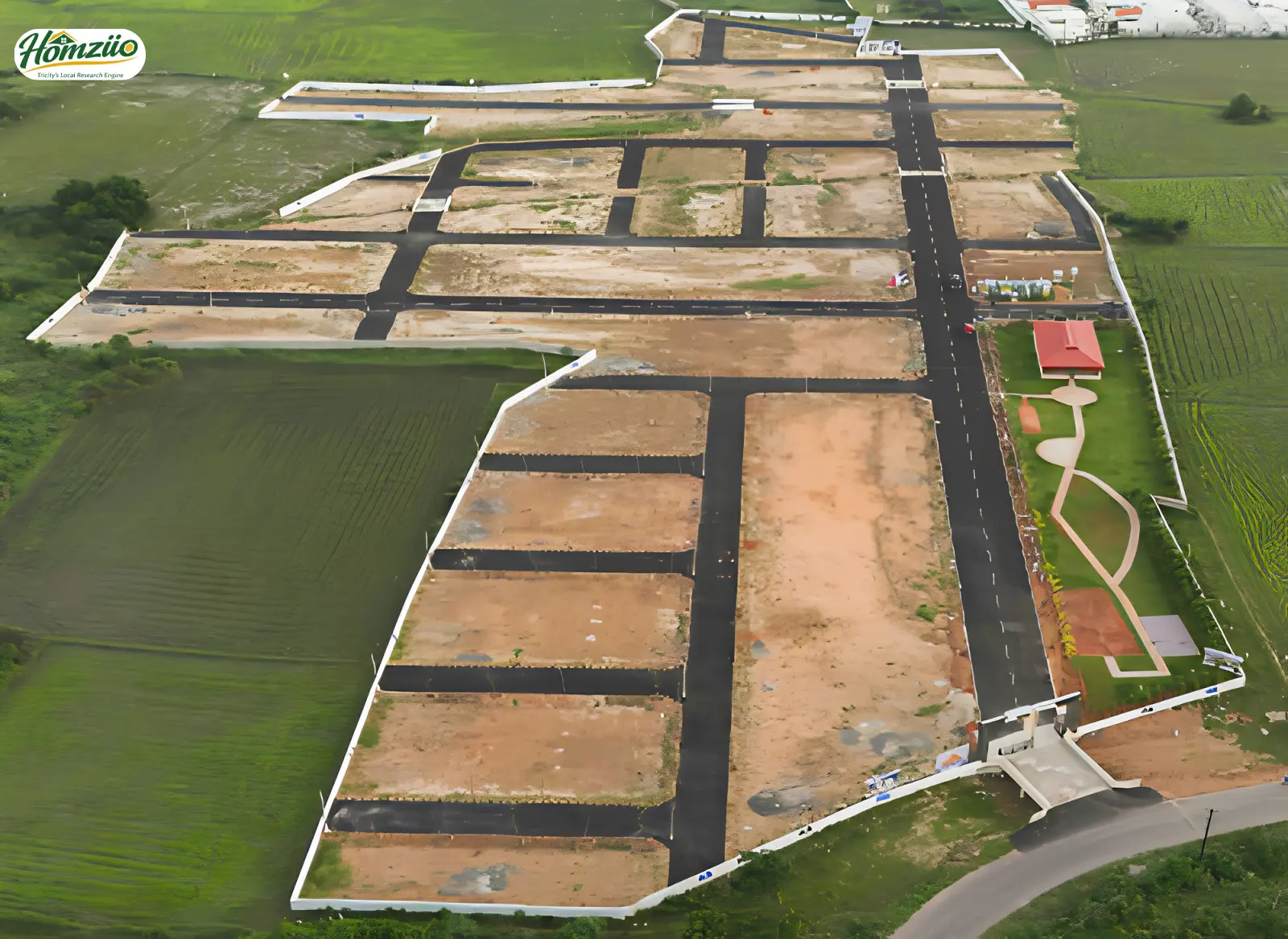
- Plotted developments in New Chandigarh and Aerocity Extension
- Rental housing near universities and IT hubs
Rental yield, in particular, is a growing story. With thousands of young professionals and students moving into Mohali every year, investors who own well-located residential units are seeing consistent occupancy and attractive rental income.
Mohali vs. Gurugram: The Honest Comparison
Gurugram is a great city - but it is a mature market. The big returns have already been made. Property prices are high, traffic congestion is a known challenge, and infrastructure in many parts grew faster than planning could keep up with.
Mohali, by contrast, is at an earlier and better-managed stage of development. It offers wide roads, sector-based urban planning, managed traffic flow, and significant green spaces, things that Gurugram struggled to maintain during its rapid growth phase.
From a pure investment standpoint, Mohali is currently positioned where Gurugram was 15 to 20 years ago. The growth fundamentals are strong, the prices are still accessible, and the upside potential is considerably higher than what a mature market like Gurugram can offer today.
What Smart Investors Are Doing Right Now
The investors who built wealth through Gurugram real estate were not the ones who bought after the city became famous. They were the ones who recognized the early signals - corporate expansion, infrastructure investment, institutional growth and acted before the crowd arrived.
Those same signals are present in Mohali right now.
If you are considering investing, here is where the opportunity is strongest:
- Near IT City and Airport Road- for short-to-medium term appreciation
- Aerocity Extension and New Chandigarh- for long-term capital growth
- Near Plaksha University and Amity University- for stable rental income
As always, smart investing means verifying RERA approvals, choosing developers with a solid track record, and focusing on locations with genuine long-term fundamentals rather than short-term hype.
Conclusion: The Best Time to Act Is Before the Crowd Arrives
Mohali is no longer a city waiting to grow. It is already growing - rapidly, systematically and in the right direction. The IT expansion, the educational institutions, the infrastructure investments and the rising corporate presence are not future promises. They are present-day realities.
The question is not whether Mohali will become North India's next Gurugram. Based on the evidence on the ground, it already is becoming that. The real question is whether you will be part of that growth story early enough to benefit meaningfully.
In real estate, the most significant returns are always made by those who invest before a city fully matures, not after. Mohali is at exactly that stage today.
The opportunity is here. The fundamentals are strong. And for buyers and investors who are ready to think ahead, Mohali offers something increasingly rare in Indian real estate: a city on the rise, at a price that still makes sense.
Connect with our real estate experts today for professional guidance and make smarter property decisions with confidence.
New Projects in Mohali
View all projects in Mohali →







Rozen Singgla is a real estate analyst and co-founder of Homziio, specialising in the Chandigarh Tricity property market. With deep expertise in RERA-verified residential and commercial projects across Mohali, Zirakpur, Kharar, and Panchkula, Rozen helps buyers and investors make informed decisions backed by verified data and on-ground market insights.
News insight
 Oct 06, 2026
 Ready-to-Move vs Under-Construction Flats in Tricity: Mohali, Zirakpur, Kharar, New Chandigarh & Panchkula
Ready-to-move vs under-construction flats: which one suits you? A ready flat gives quick possession,...
 Sep 15, 2026
 Real Estate in Kharar Guide 2026: Complete Buyer's Handbook
Discover why real estate in Kharar is booming in 2026 verified prices, RERA-approved projects, top i...
 Sep 04, 2026
 GMI Infra Group: The Real Story Behind the City's Tallest Tower
GMI Infra Group started as a jewellery business in Chandigarh and grew into a well-known real estate...