
Checklist Before Buying Property: Your Ultimate Guide to a Safe Investment

Buying land is often a life-changing decision - whether for building your dream home, investing for the future, or starting a business venture. In India’s booming real estate market , choosing a trusted real estate platform can help buyers avoid costly mistakes. However, it also carries significant risks if proper due diligence is overlooked. Stories of buyers losing lakhs or getting trapped in endless legal battles over disputed titles or unapproved layouts are unfortunately quite common.
This comprehensive checklist will walk you through the essential verifications you must complete before signing any agreement. Follow it diligently, consult a reputable lawyer and consider visiting the site multiple times. A thorough check today can save you years of headaches and protect your hard-earned money.
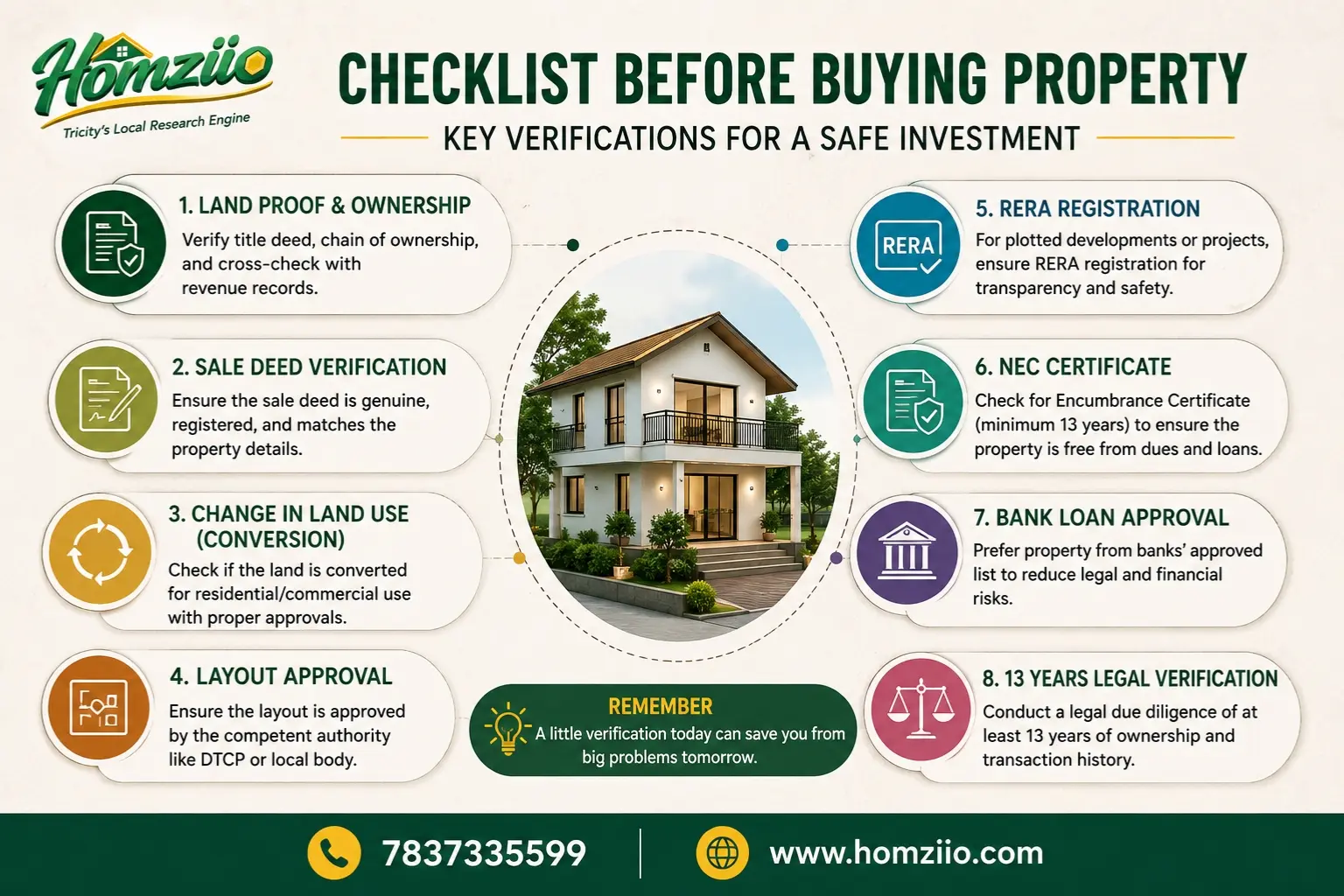
Land Proof
Land Proof, often referred to as the title deed or ownership documents, is the foundational proof that the seller has the legal right to sell the property. Without a clear and marketable title, the entire transaction can collapse later.
Start by examining the original title deed. Most of these are available on Online Platform with Govt. Website. This document establishes the seller’s ownership. Cross-verify the seller’s name with government land records (such as the Pahani or Record of Rights in many states), Aadhaar, and PAN cards. Request the “Mother Deed” or chain of previous ownership documents to trace the history.
Ludhiana NRI Land Fraud Case (2025)
In Ludhiana (Punjab), prime agricultural/commercial land near the Ladhowal-Verka bypass (measuring about 14 kanals, valued at around ₹6 crore) was fraudulently sold via a registered sale deed for a mere ₹30 lakh. The actual owner was an NRI named Deep Singh living in the US. An imposter impersonated him at the tehsil office and executed the sale deed in favor of a buyer (Deepak Goel from Panchkula). A numberdar (village revenue official) acted as a witness and local revenue officials (including a tehsildar) were allegedly involved in overlooking identity verification and discrepancies.
Buyers or investors relying on the apparent "clear" registered sale deed and local revenue records could have proceeded, especially if they didn't trace the full ownership chain, verify the seller's identity against passport/foreign records, or cross-check with the real owner (common in NRI/family-held ancestral lands). The fraud came to light during a surprise inspection by the Economic Offences Wing of the Vigilance Bureau. Multiple people, including revenue staff, were arrested. The Punjab and Haryana High Court highlighted this as part of a larger pattern where absence of owners (NRIs or distant family) is exploited through forged documents, impersonation and misuse of powers of attorney, undermining public trust in real estate.
Source: Times of India (May 22, 2025)
Verify that the land is free from any ongoing litigation. Use online portals like Bhudhaar (in some states) or visit the tehsildar’s office. A clean title proof gives you confidence that you are dealing with the rightful owner.
Sale Deed
The Sale Deed (also called conveyance deed) is the most critical document in the purchase process. It legally transfers ownership from the seller to you upon registration. Never proceed without reviewing a draft and ensuring the final registered version matches all terms.
Key elements to check in the sale deed:
- Accurate description of the property (survey number, boundaries, area).
- Consideration amount (purchase price) paid.
- Clear declaration that the property is free from encumbrances.
- Signatures of both parties and witnesses.
- Registration stamp and details from the sub-registrar’s office.
Ludhiana Boundary Wall Encroachment Dispute (2024)
In Ludhiana, on Bahadurke Road adjacent to Bazigar Basti, individuals attempted to construct a boundary wall on a plot amid an ongoing ownership dispute pending in court. The Municipal Corporation (MC) Zone A’s building branch officials received a complaint and promptly intervened to halt the construction, preventing further encroachment. Locals reportedly resisted, but officials stopped the work, emphasizing that no construction was permissible on disputed land.
This situation often arises when sale deeds or transfer documents lack precise boundary measurements, site plans, or clear demarcation references (e.g., exact north-south-east-west details, measurements in feet/meters, or linkage to revenue records/mutations). Neighbors can then claim overlapping strips or encroach during construction, leading to immediate disputes, stop-work orders, court cases and project delays.
Compare the sale deed with previous deeds to ensure consistency in measurements and ownership history.
Source: Times of Indi a (November 9, 2024).
Change in Land Use (Land Conversion)
Many plots start as agricultural land, which cannot be used for residential or commercial purposes without formal “change in land use” approval, also known as land conversion or NA (Non-Agricultural) permission. Buying without this can block construction entirely.
The process typically involves applying to the revenue department or district collector with supporting documents like the title deed, survey sketch and conversion fees. Approvals come from bodies like DTCP- Directorate of Town and Country Planning or local planning authorities depending on the state and location. Check for zoning compliance-residential, commercial or industrial and ensure it matches your intended use. Unauthorized change in land use can lead to demolition orders or hefty penalties.
Layout Approval
A valid layout approval from the competent authority (such as DTCP in many states) confirms that the plot is part of an officially planned development with proper roads, drainage, parks and utilities. Unapproved layouts often lack basic infrastructure and can face demolition risks.
Inspect the approved layout plan for your plot’s location, dimensions and access roads. Verify that common areas are not encroached upon and that the developer has provided amenities as promised. You need to visit the local planning authority office or check online portals for layout sanctions. This step is crucial for resale value and livability.
RERA No. and Why RERA is Important
RERA (Real Estate Regulation and Development Act) registration is a game-changer for buyers. Every qualifying real estate project (typically over 500 sqm or 8+ units) must obtain a unique RERA number from the state authority.
Ask for the RERA registration number and verify it on the official state RERA website. This gives access to project details, approvals, timeline and promoter information.
Why RERA is Important
RERA brings transparency, accountability and buyer protection to an industry previously plagued by delays and fraud:
- Timely delivery: Promoters must complete projects on schedule or face penalties and interest payments to buyers.
- Transparency: Detailed disclosures on project plans, finances and approvals prevent hidden surprises.
- Escrow account: Funds are used only for the project, reducing diversion risks.
- Grievance redressal: Fast-track resolution mechanisms through RERA authorities.
- Quality assurance: Buyers can claim compensation for defects.
Real-life example: Sneha booked a plot in a RERA-registered project in Gurgaon. When the developer delayed possession, she claimed interest as per RERA rules and received compensation without lengthy court battles. In contrast, her colleague lost money in a non-RERA project that was abandoned midway. RERA-registered projects build trust and significantly reduce risks for land buyers.
Corporate Office Verification
Always visit the developer’s or seller’s “Corporate Office”. This helps verify legitimacy and assess professionalism. A registered office with proper staff, documentation access and transparency indicates a serious player.
Check company details on the Ministry of Corporate Affairs (MCA) portal-registration, directors and financial status. Speak to past clients or visit completed projects.
Bank Loan by Nationalised Bank
If a nationalised bank has sanctioned loans for the project or individual plots, Apartments and Commercial: it is a strong positive signal. Banks conduct rigorous due diligence on titles, approvals and legal clearances before lending. You have to ask for Bank Sanction Letters or confirm if the project is listed for home/land loans by banks like SBI, PNB or Canara Bank etc.. This adds an extra layer of credibility.
NEC (Non-Encumbrance Certificate)
A “Non-Encumbrance Certificate (NEC)” or Encumbrance Certificate (EC) confirms that the property is free from any mortgages, loans, liens or legal claims. It is issued by the sub-registrar’s office and covers a specified period (ideally 13+ years).
Obtain the latest NEC/EC and cross-check it with your lawyer’s title search. Even minor unregistered claims can surface later.
Maximum 13 Years Legal Check
Lawyers and banks typically recommend a “Title Search Covering at least 13 years” (often 30 years for extra safety). This aligns with the 12-year limitation period under the Limitation Act for most property disputes, with an extra buffer year. A comprehensive search traces ownership history, checks for disputes, mutations, and encumbrances. Engage an experienced local advocate for a Title Search Report (TSR).
Kotkapura (Faridkot district) Ancestral Land Sale Dispute (1988–2025)
In 1988, Ved Pal purchased about 92 kanals of agricultural land in Kotkapura, Faridkot district, Punjab, through a registered sale deed from three brothers (sons of late Harbans Singh) for ₹3.69 lakh. The transaction appeared straightforward, with the sellers citing family necessity (funds used to establish a cloth house business). The buyer conducted some due diligence and the deed was executed and registered.
However, in 1992, the sons of the selling brothers filed a civil suit challenging the sale. They claimed the land was ancestral coparcenary property (joint family property) and that their fathers could not sell it without proper legal necessity or consent of all coparceners. This hidden family/partition-related dispute (stemming from how the land had been inherited and treated in family records/mutations) dragged the matter through trial court, first appellate court and finally the Punjab & Haryana High Court - spanning nearly 37 years.
The High Court eventually upheld the buyer’s title (ruling the property was self-acquired, not ancestral, the sale was for legal necessity and the challenge was also hit by limitation), but the prolonged litigation caused massive delays, uncertainty and costs for the purchaser.
Confirmed Source: The Indian Express (November 6, 2025) - Article link.
Final Tips for Land Buyers
- Engage a lawyer early and conduct a physical site visit.
- Check property tax receipts, khata certificates and utility bills.
- Verify access roads and surrounding development.
- Budget for registration, stamp duty and future conversion costs.
- Avoid pressure tactics or “limited time” offers that discourage due diligence.
Buying land is an investment in your future. By following this checklist-verifying land proof, sale deed, land use changes, layout approvals, RERA registration , corporate credibility, bank financing, NEC and a robust 13-year legal check-you minimize risks and maximize returns. Real estate rewards the patient and diligent buyer.
Consult professionals, trust verified documents over verbal assurances and turn your land purchase into a success story. Reach out to our expert team today and get professional investment advice to grow your hard-earned money for a brighter future. Happy investing!







Rozen Singgla is a real estate analyst and co-founder of Homziio, specialising in the Chandigarh Tricity property market. With deep expertise in RERA-verified residential and commercial projects across Mohali, Zirakpur, Kharar, and Panchkula, Rozen helps buyers and investors make informed decisions backed by verified data and on-ground market insights.
News insight
 Oct 06, 2026
 Ready-to-Move vs Under-Construction Flats in Tricity: Mohali, Zirakpur, Kharar, New Chandigarh & Panchkula
Ready-to-move vs under-construction flats: which one suits you? A ready flat gives quick possession,...
 Sep 15, 2026
 Real Estate in Kharar Guide 2026: Complete Buyer's Handbook
Discover why real estate in Kharar is booming in 2026 verified prices, RERA-approved projects, top i...
 Sep 04, 2026
 GMI Infra Group: The Real Story Behind the City's Tallest Tower
GMI Infra Group started as a jewellery business in Chandigarh and grew into a well-known real estate...